
Vietnam Clothing Manufacturer Guide: Sourcing Strategy for 2026
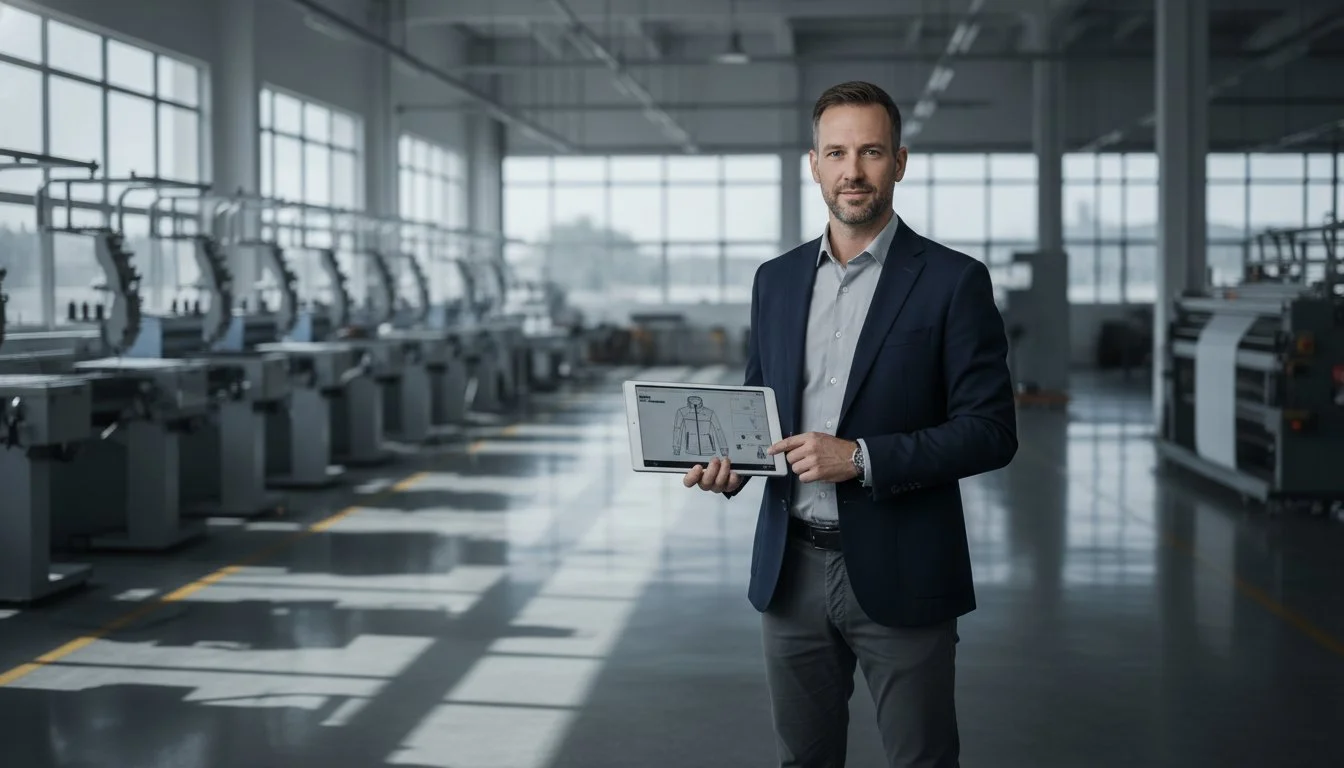
Vietnam Clothing Manufacturer Guide: Sourcing Strategy for 2026.
By 2026, the "China Plus One" strategy is no longer an optional hedge; it's a mandatory shift for brands aiming to protect their margins against rising global volatility. Securing a reliable vietnam clothing manufacturer has become the primary objective for production managers who need to diversify without sacrificing technical precision. You've likely felt the frustration of quality drift or the anxiety of sending deposits to overseas factories where you have zero legal leverage. It's a common pain point that often stalls growth and drains cash flow through inflated minimum order quantities.
This guide delivers a strategic roadmap to bridge the gap between Southeast Asian manufacturing expertise and Western business standards. You'll learn how to implement a sourcing framework that prioritizes low-volume flexibility, ensures US-based contract security, and leverages Vietnam's $47 billion textile infrastructure. We'll examine the technical vetting process for facilities, the logistics of end-to-end supply chain optimization, and the specific protocols required to maintain premium quality across every production run. Our goal is to transform your sourcing from a logistical headache into a scalable competitive advantage.
Key Takeaways
Master the "China Plus One" strategy to diversify your supply chain and capitalize on duty-free export opportunities through global trade agreements.
Evaluate technical capabilities by understanding the shift from CMT to Full Package Production, ensuring access to in-house pattern making and digital grading.
Eliminate the "Trust Gap" in overseas sourcing by integrating US legal protections into your intellectual property and production agreements.
Implement an agile inventory model with 150-unit MOQs to maintain high-quality standards while minimizing waste and upfront capital risk.
Align your brand with a premier vietnam clothing manufacturer that combines Western management efficiency with expert technical craftsmanship in activewear and streetwear.
Table of Contents
Why Vietnam is the Strategic Choice for Apparel Brands in 2026
Identifying Tier-1 Capabilities in a Vietnam Clothing Manufacturer
Solving the Trust Gap: US Legal Protection in Overseas Sourcing
Scaling for Success: Navigating Low MOQs and Bulk Production
Why Vietnam is the Strategic Choice for Apparel Brands in 2026
Global supply chain resilience in 2026 hinges on the "China Plus One" strategy. Brands are no longer willing to risk over-dependence on a single geographic source. Vietnam has emerged as the primary beneficiary of this structural shift. The country's garment export turnover reached approximately $44 billion in 2022, and current projections indicate steady growth as infrastructure projects in Hai Phong and Da Nang increase logistics efficiency. Choosing a vietnam clothing manufacturer offers more than just a backup plan; it provides a sophisticated production partner capable of handling complex technical requirements in activewear, streetwear, and high-end fashion.
Trade dynamics play a critical role in this strategic migration. The EU-Vietnam Free Trade Agreement (EVFTA), which became effective in August 2020, has systematically reduced tariffs to zero for most apparel categories. This makes Vietnam the most cost-effective hub for brands targeting the European market. This economic transition is part of a larger overview of manufacturing in Vietnam, showing a clear move from low-value assembly to high-tech industrial production. To succeed, brands must distinguish between the two primary facility types in the region:
Tier 1 Facilities: These provide end-to-end, full-package (FOB) solutions, including material sourcing, pattern development, and global logistics management.
Tier 2 Facilities: These focus on specialized assembly or CMT (Cut, Make, Trim) services, often acting as high-precision subcontractors for specific product lines.
The Shifting Landscape of Global Garment Sourcing
Production is rapidly migrating from traditional hubs to specialized clusters around Hanoi and Ho Chi Minh City. We're seeing a surge in boutique factories that cater specifically to mid-market luxury brands requiring smaller MOQs and higher stitch precision. The 2026 Vietnam Advantage combines a highly skilled technical workforce with modernized port infrastructure to deliver luxury-grade quality at a scalable commercial speed.
Sustainability and Ethical Standards in Vietnamese Factories
Modern apparel brands demand transparency and accountability. Vietnamese manufacturers are meeting this by securing SA8000 and WRAP certifications, ensuring ethical labor practices are documented and auditable. Beyond social compliance, factories are investing heavily in green technology. Many vietnam clothing manufacturer partners now offer recycled polyester and GOTS-certified organic cotton as baseline options. This shift toward eco-friendly fabric sourcing allows brands to meet 2026 sustainability targets without compromising on lead times. Proactive transparency is now the standard, moving ethical production from an optional add-on to a foundational requirement for any strategic partnership.
Identifying Tier-1 Capabilities in a Vietnam Clothing Manufacturer
Selecting a vietnam clothing manufacturer for 2026 involves vetting technical infrastructure rather than just factory capacity. Tier-1 partners distinguish themselves through vertical integration and digital-first workflows. You need a partner that acts as a strategic extension of your design team, not just a sewing facility.
FPP vs. CMT: Which Model Suits Your Brand?
The distinction between Full Package Production (FPP) and Cut, Make, Trim (CMT) defines your operational involvement. FPP is an end-to-end service where the factory manages fabric sourcing, pattern making, and logistics. It's the standard for brands seeking a streamlined "source-to-shelf" solution. In contrast, CMT requires you to supply all raw materials, including fabric and notions. While CMT offers granular control over material costs, it adds significant logistical overhead and risk.
Agile brands often favor FPP because it shifts the burden of supply chain management to the factory. Recent industry data shows that brands prioritizing resilience in Asian apparel manufacturing are increasingly shifting toward FPP partners to mitigate logistics risks. If you want to dive deeper into these mechanics, read our guide on Full Package Production (FPP): What It Is.
Technical Development and Prototyping Excellence
Precision begins with the technical package. A comprehensive tech pack serves as the definitive blueprint for your garment, containing graded spec sheets, bills of materials, and construction details. Without this, bulk errors are inevitable. High-tier factories use digital pattern making and 3D sampling software to reduce physical prototype iterations, which can shave 14 to 21 days off your development timeline. You can learn How a Detailed Tech Pack Reduces Production Costs to optimize your pre-production budget.
Activewear and performance apparel require specialized machinery that standard factories don't possess. Look for facilities equipped with 4-needle 6-thread flatlock stitching machines for chafe-free seams and heat-sealing equipment for waterproof, bonded finishes. These technical capabilities are non-negotiable for high-performance collections.
Quality isn't an afterthought; it's baked into the sampling phase through a 3-layer quality control system:
Raw Material Inspection: Testing fabric for shrinkage, colorfastness, and GSM consistency before cutting.
In-Line Checking: Real-time monitoring of sewing lines to catch construction deviations early.
Final AQL Audit: A rigorous final inspection based on AQL 2.5 or 4.0 standards to ensure every unit meets retail requirements.
If you're unsure which model fits your current scale, consult with our production team to evaluate your specific vietnam clothing manufacturer requirements and streamline your 2026 strategy.
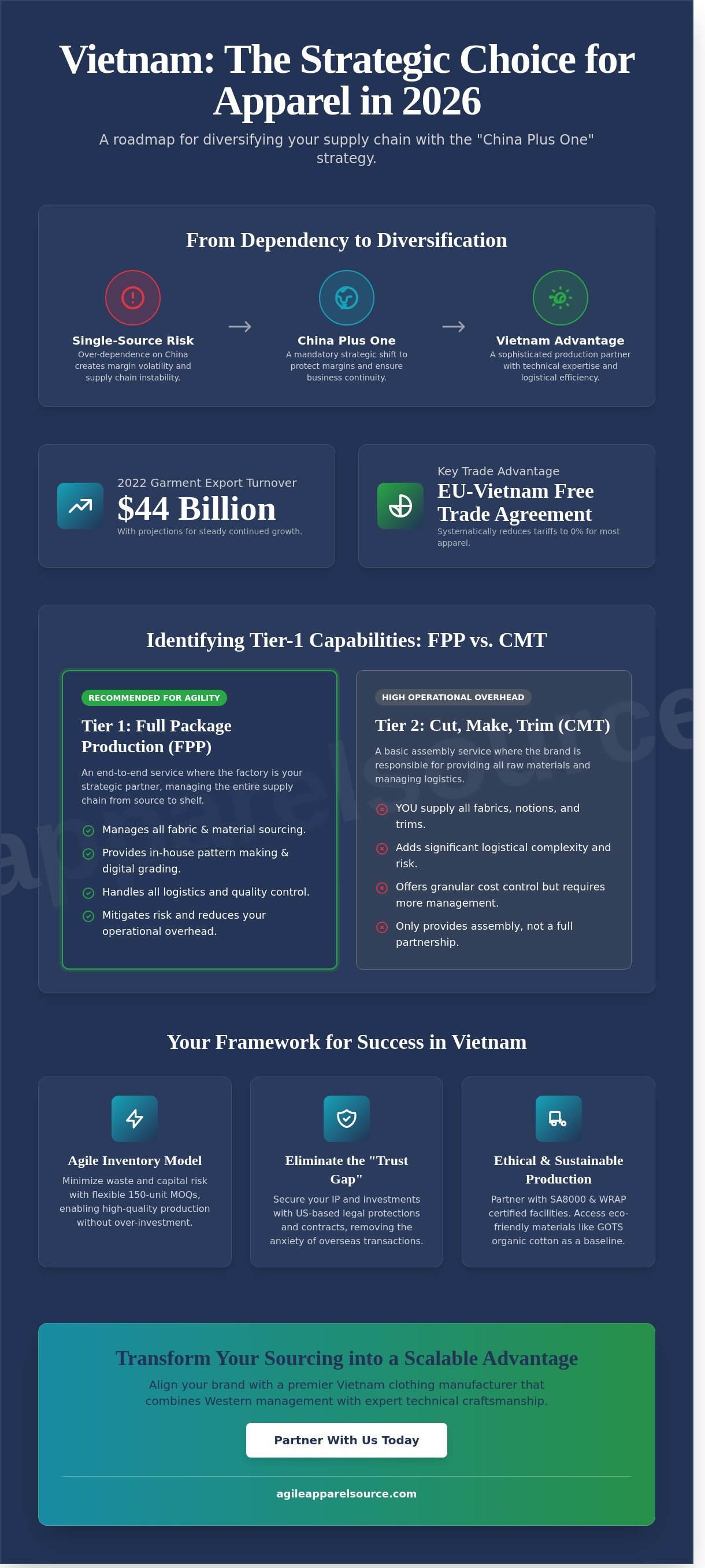
The Strategy Choice for Brand 2026
Solving the Trust Gap: US Legal Protection in Overseas Sourcing
Directly engaging a vietnam clothing manufacturer without a domestic intermediary exposes your brand to significant jurisdictional risks. If a production run fails or a contract is breached, seeking legal recourse in Vietnamese courts requires navigating a foreign legal system, high translation costs, and years of litigation. A US-based partner operates as a strategic bridge, providing a domestic legal framework that absorbs these complexities. This structure ensures that your primary point of contact is accountable under US law, streamlining dispute resolution and financial settlements.
The fixer approach goes beyond simple matchmaking. It involves managing the entire logistical stack, including customs and duties, before they become bottlenecks. By handling these technical hurdles, a US-based partner ensures your supply chain remains resilient against shifting trade policies. This strategic alliance allows your team to focus on design while the manufacturing partner secures the following:
Enforceable domestic contracts that mitigate financial loss.
Direct oversight of Vietnamese factory floors to prevent unauthorized subcontracting.
Pre-emptive logistics planning to navigate 2026 shipping regulations and Section 301 tariff updates.
Transparent financial transactions that eliminate the risks of international wire fraud.
Protecting Your Intellectual Property (IP)
Sending tech packs to unvetted overseas factories is a primary risk for emerging brands. Without a US-governed contract, your proprietary patterns and technical specifications are vulnerable to design leakage or unauthorized overproduction. Intellectual property theft often occurs when factories run ghost shifts to sell your designs to third-party competitors. Utilizing a US-based legal entity transforms your manufacturing agreement from a hopeful handshake into an enforceable domestic asset. This legal shield ensures that your vietnam clothing manufacturer adheres to strict confidentiality, protecting your brand's market exclusivity from concept to consumer.
On-the-Ground Quality Control in Vietnam
Remote sourcing frequently results in quality fade, where the initial samples meet standards but bulk production units show declining craftsmanship. Maintaining a high-performance supply chain requires dedicated QC teams stationed in production hubs like the Red River Delta or Ho Chi Minh City. These local experts conduct mid-line inspections to catch stitching errors or fabric inconsistencies before they escalate into terminal defects. By bridging the communication gap between US design teams and the factory floor, these teams ensure that technical requirements aren't lost in translation. This proactive energy keeps your production on track, delivering retail-ready goods that meet your exact specifications every time.
Scaling for Success: Navigating Low MOQs and Bulk Production
A persistent misconception suggests that every vietnam clothing manufacturer only services industry titans like Nike or Zara. While Vietnam remains a global hub for massive volume, the 2026 landscape has shifted toward high-mix, low-volume production. Factories now offer 150-unit MOQs (Minimum Order Quantities). This shift enables brands to implement agile inventory management, which can reduce textile waste by up to 30% compared to traditional bulk forecasting. Scaling isn't about starting big; it's about starting smart.
The Strategy of Low MOQ Manufacturing
Small-batch production eliminates the heavy financial burden of sitting on unsold stock. By launching with 150 units, emerging fashion lines can test market demand without over-leveraging capital. Transitioning from 150 to 1,500 units requires a disciplined approach to quality control. We ensure that the gold seal sample approved during development remains the benchmark for every subsequent production run. For a deeper look at this process, see [The Founder's Guide to Low MOQ Manufacturing](The Founder's Guide to Low MOQ Manufacturing). Maintaining consistency during rapid growth depends on standardized tech packs and rigorous in-line inspections.
Lead Times and Production Cycles
Effective planning for 2026 requires understanding the specific mechanics of the Vietnamese supply chain. Technical garments, such as seam-sealed outerwear or performance activewear, require longer windows due to specialized machinery requirements. Standard timelines currently follow a predictable sequence:
Fabric Sourcing and Lab Dips: 3 to 5 weeks depending on mill location.
Sample Development: 2 to 4 weeks per iteration.
Bulk Manufacturing: 8 to 12 weeks from the date of PO issuance.
Proactive brands must account for the Tet Lunar New Year. This holiday often shuts down production for 10 to 14 days in late January or February, creating a backlog that affects the entire first quarter. Fabric availability remains the primary driver of speed. Choosing local Vietnamese mills can shave 15 days off the total lead time. When you partner with a vietnam clothing manufacturer, transparency regarding these milestones is non-negotiable for maintaining a consistent retail drop schedule. We prioritize clear communication to ensure your samples transition into bulk production without technical friction.
Ready to streamline your supply chain and reduce inventory risk? Partner with Agile Apparel Source for scalable production solutions.
Agile Apparel Source: Your Strategic Partner in Vietnam
Selecting a vietnam clothing manufacturer requires more than identifying a factory with available floor space. It demands a sophisticated bridge between Western brand expectations and Eastern production execution. Agile Apparel Source operates through a lens of American business management, ensuring that communication, quality benchmarks, and deadlines align with US market standards. We merge this rigorous oversight with the generational craftsmanship found in Vietnam's premier textile regions. This strategic hybrid model eliminates the traditional friction of offshore sourcing, allowing your brand to leverage Southeast Asian cost efficiencies without sacrificing professional transparency.
Our infrastructure is built for the 2026 fashion cycle, where speed and flexibility dictate market share. We provide a comprehensive source-to-shelf solution that manages every technical detail. From the initial tech pack audit to complex international logistics, our team acts as an integrated extension of your design department. We don't just execute orders; we optimize supply chains to ensure your inventory arrives retail-ready and on schedule.
Scalability remains a core challenge for modern labels. While many regional factories demand minimums of 1,000 units per style, our 150-unit MOQ offers a competitive entry point. This lower threshold allows brands to test new silhouettes, respond to micro-trends, and manage capital without the burden of excessive deadstock. It's a lean manufacturing approach that supports both emerging designers and established retailers looking to diversify their collections.
Our Production Specializations
High-performance activewear: We utilize seamless technology, compression fabrics, and moisture-wicking treatments to create gear that meets professional athletic standards.
Streetwear & Casuals: Our facilities excel in heavyweight knits, intricate embroidery, and specialized garment washes that define the premium streetwear aesthetic.
Eco-friendly options: We maintain direct access to Vietnam's sustainable textile hub, sourcing GOTS-certified organic cottons and recycled polyesters to meet modern ESG requirements.
Getting Started with Agile Apparel Source
Our onboarding process is designed for speed and technical precision. It begins with a detailed inquiry phase where we align on your brand’s specific volume and quality needs. We then move into a rigorous Tech Pack Audit, where our engineers review your blueprints to prevent costly production errors. Finally, we execute a rapid sampling phase to ensure the physical product matches your digital vision before the main run begins.
Security is a non-negotiable aspect of our partnership. Every contract is backed by US legal frameworks, providing intellectual property protection and financial recourse that direct-to-factory relationships often lack. This structure ensures that your designs remain your property and your investment is protected by enforceable standards. You can start your production journey with a custom quote today to see how our integrated model can streamline your 2026 manufacturing strategy.
Secure Your Competitive Edge in 2026
Navigating the 2026 apparel landscape requires more than just finding a vendor; it demands a strategic alliance that mitigates risk while maximizing agility. Vietnam has solidified its position as the premier hub for technical excellence and sustainable production. By leveraging tier-1 facilities that offer 3-layer on-the-ground quality control, you ensure every garment meets rigorous standards before it leaves the factory floor. Our team acts as an essential extension of your own, managing the source-to-shelf lifecycle so you can focus on creative growth.
Trust remains the biggest hurdle in overseas sourcing. We solve this by providing US-based legal protection, giving your brand the security of domestic oversight with the cost benefits of global production. Whether you're testing new concepts with our accessible 150-unit MOQs or scaling into full-scale bulk runs, our end-to-end management keeps your supply chain lean and responsive. Your production shouldn't be a source of stress. It's time to build a resilient, scalable foundation for your next collection. We're ready to help you lead the market with precision and speed.
Scale your brand with a reliable vietnam clothing manufacturer; Get Started Today
Frequently Asked Questions
Why should I choose a Vietnam clothing manufacturer over one in China?
Vietnam offers a strategic hedge against supply chain volatility and benefits from 15 active free trade agreements, including the CPTPP. While China remains a manufacturing giant, Vietnam provides a 15% to 20% lower labor cost according to recent JETRO reports. Brands choose a vietnam clothing manufacturer to capitalize on duty-free access to the EU and UK markets through the EVFTA and UKVFTA agreements.
What is the typical minimum order quantity (MOQ) for Vietnamese factories?
Minimum order quantities in Vietnam typically range from 500 to 1,000 units per style for most mid-tier factories. Smaller boutique facilities might accept 100 to 300 units, but these often command a 20% price premium. We help you navigate these requirements by matching your volume with factories that prioritize your specific scale and growth trajectory, ensuring your production remains scalable and cost-effective.
How do I ensure the quality of my garments when manufacturing overseas?
You'll secure quality by implementing a multi-stage inspection process that follows the AQL 2.5 standard. Most reputable factories work with third-party agencies like SGS or Intertek to conduct mid-line and final random inspections. We suggest establishing a clear Quality Management System before production begins to ensure every garment meets the technical specifications and tolerance levels outlined in your original tech pack.
Do I need to visit Vietnam to manage my clothing production?
You don't need to be physically present in Vietnam to manage your production successfully. Digital communication tools and detailed PLM software allow for real-time tracking of the manufacturing lifecycle. Professional sourcing partners act as your eyes on the ground, conducting factory audits and quality checks so you can focus on scaling your brand from your home office without the expense of international travel.
How long does it take to produce a bulk order in Vietnam?
Bulk production lead times generally span 60 to 90 days after your final sample approval. The timeline breaks down into 3 to 4 weeks for fabric sourcing and lab dips, followed by 6 to 8 weeks for actual garment construction. These timelines vary based on seasonal demand peaks in Q3 and the complexity of your specific designs, so we recommend starting development 6 months before your target launch.
Can Vietnamese manufacturers help with fabric sourcing and tech packs?
Most factories offer Full Package Production services, which include comprehensive fabric sourcing and technical development. A professional vietnam clothing manufacturer can often translate your rough sketches into production-ready tech packs and graded size charts. This end-to-end support streamlines the transition from concept to final product, reducing the risk of communication errors and ensuring your designs are optimized for mass production efficiency.
What are the shipping costs and duties for apparel from Vietnam to the US?
Shipping from Ho Chi Minh City or Hai Phong to US ports typically takes 25 to 35 days via ocean freight. While Vietnam doesn't have a free trade agreement with the US, it avoids the Section 301 tariffs currently applied to Chinese goods. You'll pay standard MFN duty rates, which vary by garment category according to the Harmonized Tariff Schedule, often ranging between 10% and 32%.
Is it possible to find sustainable and ethical manufacturers in Vietnam?
Vietnam is a leader in ethical manufacturing, with over 400 factories currently participating in the Better Work Vietnam program. You'll find numerous LEED-certified facilities that prioritize water recycling and solar energy. We vet every partner for WRAP or BSCI certifications to ensure your supply chain meets the 2026 standards for social and environmental governance, moving beyond compliance to strategic value creation.
As a leading sourcing agent in Vietnam, Agile Apparel Source helps you choose the right high-performance fabrics for your collection. Contact us for a technical consultation. Ready to start your collection? Click here to get a Low MOQ quote.
