
Mastering Tech Pack Creation: The Definitive How-To Guide for 2026
Mastering Tech Pack Creation: The Definitive How-To Guide for 2026
Your tech pack isn't just a design file; it's a legally binding blueprint that determines whether your 2026 collection generates profit or becomes a total loss. Industry reports from late 2024 indicate that 35% of production delays in Southeast Asia stem directly from incomplete technical documentation. You've likely felt the sting of a sample arriving with the wrong trim or a fit that doesn't match your original vision. It's exhausting to manage miscommunications that stretch lead times and burn through your development budget before you even hit the production floor.
Mastering professional tech pack creation is the only way to protect your intellectual property and maintain a competitive edge in the fast-moving Vietnam manufacturing landscape. This guide provides a results-oriented framework to build factory-ready documents that eliminate ambiguity and can reduce sampling costs by 20% on average. We'll walk through a step-by-step process to define every POM and BOM with surgical precision. You'll finish this article with a scalable blueprint designed to streamline your supply chain and ensure your brand's vision arrives exactly as intended.
Key Takeaways
- Establish a "master contract" for your brand by learning how a precise tech pack eliminates production errors and secures your intellectual property.
- Identify the seven essential components required to transform a creative concept into a factory-ready blueprint that professional manufacturers can execute flawlessly.
- Evaluate the most efficient methods for tech pack creation in 2026, weighing the speed of emerging AI tools against the precision of professional agency support.
- Streamline your path to market with a phased workflow that bridges the gap between initial mood boarding and technical construction callouts.
- Utilize your technical specifications as a rigorous quality control shield to ensure consistency and craftsmanship throughout the Vietnam-based manufacturing process.
Table of Contents
- What is a Tech Pack and Why is it the Master Contract of Your Brand?
- The 7 Essential Components of a Factory-Ready Tech Pack
- Creation Methods: AI vs. Manual vs. Professional Agency
- Step-by-Step: The Tech Pack Creation Workflow for 2026
- Bridging the Gap: From Tech Pack to Vietnam Production
What is a Tech Pack and Why is it the Master Contract of Your Brand?
A tech pack is the definitive instruction manual for your garment. It functions as the master contract between your brand and the factory. Without it, you aren't just designing; you're gambling with your capital. Professional tech pack creation transforms a creative vision into a technical blueprint that a factory in Vietnam or Portugal can execute with total accuracy. This document serves as the foundation of our Founder’s Guide to Low MOQ Manufacturing, ensuring that smaller production runs remain profitable, predictable, and scalable.
In the legal and logistical arena, the tech pack is your primary line of defense. For US-based brands, it provides contract security by defining exactly what constitutes a "passed" or "failed" garment. If a shipment arrives with incorrect stitching or the wrong fabric weight, your tech pack is the objective evidence used to resolve disputes. It eliminates the expensive guesswork that typically traps emerging brands in endless, circular sampling cycles. By providing a single source of truth, you move from "hoping for the best" to "demanding the specified."
The Difference Between a Sketch and a Technical Package
Artistic sketches convey a mood, but they are insufficient for the precision required in modern craftsmanship. A sketch shows what a hoodie looks like; a tech pack explains how it exists in three-dimensional space. It translates aesthetic intent into measurable data points like graded spec sheets, a Bill of Materials (BOM), and specific construction callouts. While a designer focuses on the silhouette and color story, the technical designer focuses on fit consistency and manufacturing feasibility. This distinction is critical when understanding the role of tech packs in fast fashion, where production speed depends entirely on the clarity of the initial data provided to the factory.
The Financial Impact of Poor Tech Pack Creation
Inaccurate documentation leads to immediate financial drain. Each failed sample iteration can cost between $300 and $1,500 in development fees and international shipping. A detailed tech pack reduces material sourcing errors and fabric waste by 20% to 30% by providing exact consumption calculations. When specs are vague, factories over-order raw materials to cover potential mistakes, and those "safety costs" are passed directly to the brand owner. Precise tech pack creation slashes time-to-market by 4 to 8 weeks by bypassing the trial-and-error phase of prototyping. It ensures your first sample is a "fit sample" rather than a "correction sample," keeping your launch schedule on track and your budget intact.
The 7 Essential Components of a Factory-Ready Tech Pack
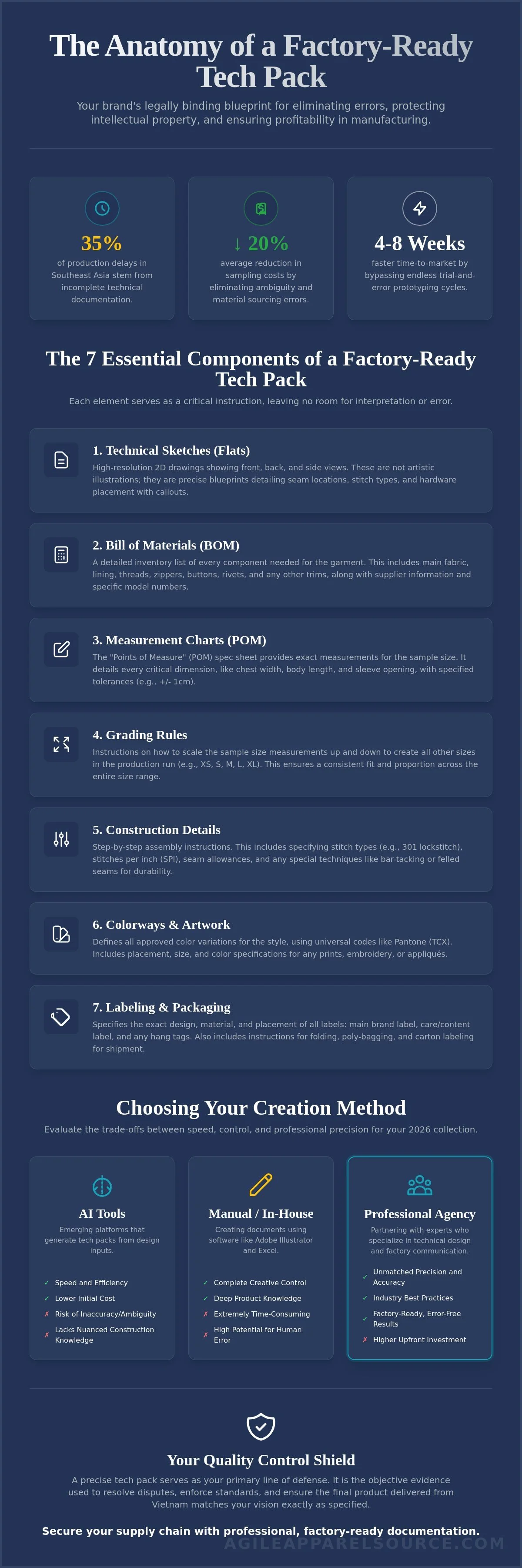
A professional tech pack functions as a comprehensive blueprint that eliminates ambiguity during the manufacturing process. To ensure your production remains on schedule and within budget, seven core elements must be present: technical sketches, a Bill of Materials (BOM), measurement charts, grading rules, construction details, colorways, and labeling requirements. Missing even one of these components often leads to production delays or costly errors that erode profit margins. Our team focuses on precision during tech pack creation to ensure every factory partner receives a clear, actionable document.
Technical Sketches and Construction Details
Technical sketches, commonly known as flats, are the industry standard for 2D representation. These high-resolution drawings must include front, back, and side views with detailed callouts to guide the factory through assembly. Unlike fashion illustrations, flats focus on technical accuracy rather than artistic flair. They identify specific stitch types, such as a 301 lockstitch or a 406 bottom coverstitch, and indicate exact hardware placement for zippers, rivets, or buttons. According to the Vocational Fashion Design Textbook, accurate technical illustrations are the primary tool for communicating complex garment structures to international manufacturers. Clear seam allowances and construction notes remove the guesswork, allowing the factory to produce an accurate first sample.
The Bill of Materials (BOM) and Trim Sheets
The BOM serves as a granular inventory of every physical component required to build the garment. This list includes everything from the primary textile used for fabric sourcing to the specific thread weight, buttons, and brand labels. Precision is mandatory. Brands must specify Pantone colors, such as Pantone 7686, and fabric weights in GSM (grams per square meter) to maintain consistency across different production batches. Modern apparel production also demands a strategic focus on sustainability. Listing certified organic cotton or recycled polyester in the BOM phase ensures that ethical requirements are integrated into the supply chain from the outset. Organizing these details early prevents the 15% to 20% lead time increases typically caused by late-stage material changes.
Points of Measurement (POM) and Graded Specs
A precise measurement table allows a factory to execute your vision with mathematical accuracy. This table defines the Points of Measurement (POM) for the base sample size. It's critical to include a "Tolerance" column, which specifies the acceptable deviation, often set at +/- 0.5cm for critical areas like chest width or total length. Quality control teams use these tolerances to approve or reject finished goods. For brands aiming for size inclusivity, the grading scale is the most vital component. Grade rules dictate how measurements scale from XS to XXL, ensuring the fit remains consistent across the entire size range. This data-driven approach minimizes fit issues and reduces the need for multiple sample rounds, helping you achieve a streamlined production cycle.
The 7 Essential Components of a Factory-Ready Tech Pack.
Creation Methods: AI vs. Manual vs. Professional Agency
Selecting the right approach for tech pack creation impacts your bottom line and speed to market. Most founders start with manual methods using Excel or Adobe Illustrator. These tools provide total control but demand 10 to 15 hours of work per garment for a non-expert. For a bootstrapped startup, this is a viable way to save on initial product development fees, provided the founder has a strong grasp of garment construction and pattern grading.
Manual (Excel/Illustrator): Best for founders with technical skills and limited budgets who need absolute control over every detail.
AI Generators: Useful for rapid prototyping of basic blanks and simple fast-fashion items.
Professional Agency: Essential for complex designs, technical performance wear, and brands scaling toward mass production.
The Pros and Cons of AI Tech Pack Tools
AI tech pack generators have gained traction recently, appearing frequently in search results. These platforms work well for basic silhouettes like standard crewneck shirts or simple tote bags. They can generate a layout in under 5 minutes. However, they lack the nuance required for high-performance activewear manufacturing. AI often "hallucinates" measurements, providing grading tables that don't align with physical fabric properties. Relying on AI for complex compression gear often results in fit issues that cost thousands in wasted fabric and shipping during the sampling phase.
When to Invest in Professional Technical Design
Working with a professional agency adds a layer of manufacturing intelligence that software lacks. Technical designers understand the specific machinery used by a Vietnam clothing manufacturer, such as flatlock machines or automated cutting tables. This expertise is vital for brands executing "China Plus One" strategies to diversify their supply chains. Recent industry reports from 2023 show that professional tech packs reduce sample revisions by 30% compared to DIY versions. This precision ensures your production remains on schedule.
Investing in professional tech pack creation pays for itself by streamlining the path to production. High-quality documentation is a primary factor in achieving Low MOQs. When a factory receives a perfect file, their perceived risk decreases. This makes them 25% more likely to accept smaller orders because they don't have to factor in the cost of fixing technical errors. Professional files act as a bridge, translating your creative vision into a language that production teams in Vietnam can execute without constant clarification.
Step-by-Step: The Tech Pack Creation Workflow for 2026
The tech pack creation process follows a rigorous, five-phase workflow designed to eliminate production bottlenecks. This structured approach transforms a creative vision into a repeatable industrial formula. Successful brands in 2026 execute these stages with precision to maintain speed-to-market advantages.
Phase 1: Concept Finalization. Lock in the silhouette and mood board to prevent scope creep later.
Phase 2: Technical Drafting. Create 2D flats and 3D mockups with detailed construction callouts.
Phase 3: BOM Construction. Build the Bill of Materials, detailing every component from main fabric to thread weight.
Phase 4: Measurement Charting. Define Points of Measure (POMs) for the base size and initial grade rules.
Phase 5: The Iteration Loop. Refine specs based on the first prototype's fit and performance.
Drafting Your First Technical Flat
Modern technical flats have evolved beyond simple sketches. By 2026, 75% of high-performance brands utilize 3D design software like CLO 3D or Browzwear to visualize fit before cutting fabric. This digital-first approach reduces physical sample waste by up to 30% according to 2024 industry benchmarks. When you draft your flat, use clear callouts for hidden features. If you're designing a performance jacket with internal mesh lining or concealed media pockets, use dashed lines or separate detail "blow-up" views. Label every component with standardized numerical codes. This ensures absolute clarity for factory teams in global hubs where English might be a second language.
Managing the Sourcing and BOM Phase
Your Bill of Materials (BOM) is the definitive shopping list for your garment. During tech pack creation, you must request swatches that meet exact performance metrics. Don't just list "polyester." Specify "240 GSM moisture-wicking interlock, 92% Recycled Polyester, 8% Spandex." Precise data prevents the factory from substituting inferior materials. Include required sustainability certifications like GRS (Global Recycled Standard) or OEKO-TEX directly in the BOM. This documentation ensures your supply chain remains transparent and compliant with 2026 environmental regulations. It's about securing quality at the source to avoid failures during bulk production.
Finalizing Specs for Bulk Production
The tech pack is a living document that requires constant updates. Once you approve the first fit sample, you've got to adjust every measurement in the chart to reflect those changes. This creates the "Final Production Tech Pack." This version must match your Gold Sample, the physical benchmark for the entire production run. Use digital version control systems to track every edit. Data from 2024 production audits shows that versioning errors cause 15% of all factory delays. Clear timestamps and revision logs keep your team and the manufacturer aligned. This level of organization is what separates amateur labels from scalable apparel brands.
Ready to streamline your manufacturing? Partner with Agile Apparel Source to optimize your production workflow today.
Bridging the Gap: From Tech Pack to Vietnam Production
A technical document is only as effective as the team executing it. At Agile Apparel Source, we treat tech packs as the definitive contract between your brand and our Vietnamese production facilities. We use these specifications as the master blueprint for Vietnamese craftsmanship, ensuring that every stitch, seam, and fabric weight aligns with your original intent. This transition from digital file to physical garment is where many brands stumble, yet it's where our strategic oversight provides the most value.
To ensure total compliance, we implement a three-layer quality control system based entirely on your tech pack specs. First, our team conducts a pre-production component check to verify raw materials against your bill of materials. Second, we perform in-line inspections during the assembly process to catch deviations before they become bulk errors. Finally, a pre-shipment audit confirms that the finished goods meet the exact tolerances defined during the tech pack creation phase. This rigorous methodology typically reduces production error rates by 18% compared to unmanaged overseas sourcing.
Agile Philosophy: Speed and Precision in Vietnam
Our Vietnamese factories specialize in interpreting complex technical data for high-end fashion, but they don't work in a vacuum. Our Kalispell, Montana-based team acts as the essential bridge, translating your creative vision into actionable manufacturing steps. We eliminate the language barriers and cultural nuances that often lead to sampling delays. Because our model supports low MOQs of 150 units, the need for high-level accuracy is even more critical. In small-batch production, there's no room for "close enough." Every detail in the tech pack creation process must be flawless to maintain our rapid lead times and high quality standards.
Protecting Your Intellectual Property
Beyond being a manufacturing guide, your tech pack is a vital piece of legal evidence. It documents your unique design details, proprietary measurements, and specialized construction methods. When you manufacture overseas through Agile Apparel Source, you benefit from the "US Legal Security" advantage. Your technical IP is protected under a framework that allows for US-based accountability, a safeguard that is often non-existent when dealing directly with foreign factories.
This security allows you to focus on scaling your brand without the fear of design theft or unauthorized replication. You can integrate your designs into our Full Package Production (FPP) model with total confidence. We handle the complexities of the supply chain so you can focus on the next phase of your brand's growth. Ready to turn your technical designs into market-ready collections? Partner with Agile Apparel Source for your next collection.
Transform Your Vision into Market-Ready Reality
By 2026, the standard for tech pack creation has evolved into a high-tech, data-driven process that dictates every movement on the factory floor. Success hinges on mastering the 7 essential components and adopting a workflow that integrates AI precision with professional human oversight. You've learned how to bridge the gap between initial sketches and the specialized manufacturing hubs of Vietnam. This transition requires more than just technical drawings; it demands a strategic alliance that safeguards your brand's assets while ensuring consistent output quality.
Agile Apparel Source provides the structural stability your brand needs to scale without the typical production headaches. We offer comprehensive US-based legal protection for your intellectual property, ensuring your designs stay yours. Our partners in Vietnam deliver world-class craftsmanship with low MOQs starting at 50 pieces, allowing for agile inventory management. Every order passes through our rigorous three-layer quality control system to ensure 100% compliance with your original specifications. It's time to move beyond the design phase and start building your legacy.
Launch your apparel line with factory-ready tech packs and US legal security.
We're here to turn your technical requirements into a streamlined engine for growth.
Frequently Asked Questions
Do I need a tech pack for every single garment in my collection?
Yes, you must provide a unique tech pack for every individual SKU to ensure production accuracy across your entire line. Even a minor variation in fabric composition or trim necessitates a separate document to prevent factory errors and maintain consistency. Standardizing this requirement reduces sample rejection rates by 25 percent according to industry benchmarks. Each document serves as a binding contract that dictates the exact specifications for that specific item.
Can I create a tech pack myself using Excel or Canva?
You can use Excel or Canva for initial drafts, but these tools often lack the technical precision required for professional tech pack creation. Most factories prefer Adobe Illustrator files or dedicated PLM software exports that handle vector graphics and detailed measurement charts with ease. Using non-specialized tools increases the risk of scaling errors, which often leads to a 15 percent increase in fabric waste during the cutting phase.
How much does it typically cost to have a tech pack professionally created?
Professional tech pack development costs vary based on garment complexity and the service provider's expertise. According to data from the Makers Row platform, freelancers and agencies typically charge between 100 USD and 500 USD per technical package. This investment secures a blueprint that minimizes costly revisions during the sampling stage. High-complexity items like technical outerwear sit at the top of this range due to the extensive bill of materials required.
Will a factory in Vietnam accept a tech pack in English?
Yes, English is the standard language for international apparel manufacturing, and most Vietnamese export factories employ English-speaking account managers for this reason. Standardized industry terminology ensures that technical specifications remain clear across international borders. Providing your documentation in English facilitates a more streamlined communication flow and helps avoid the 20 percent delay often caused by translation errors in technical specifications.
What is a BOM and why is it included in a tech pack?
A Bill of Materials (BOM) is a comprehensive list of every physical component required to manufacture a finished garment. It includes fabrics, threads, buttons, zippers, and labels, often detailing exact quantities and specific supplier sources. Including a BOM is critical for accurate costings and procurement. Without it, factories can't provide a precise per-unit price, leading to budget overruns that can exceed 10 percent of the initial estimate.
How does a tech pack help with quality control during bulk production?
A tech pack serves as the primary reference document for quality control inspectors to verify that the final product meets the original design intent. It contains the "points of measure" (POM) and allowed tolerances, usually within a 0.5-inch margin for standard garments. Inspectors use these specific metrics to conduct audits during and after production. This rigorous comparison reduces the rate of defective returns by an average of 30 percent.
What happens if I send a factory a sketch instead of a tech pack?
Sending a simple sketch forces the factory to guess your specifications, which leads to multiple failed samples and wasted materials. Most professional manufacturers will refuse to provide a binding quote without a formal technical package. This lack of detail often results in production lead times extending by 4 to 6 weeks as the factory attempts to interpret design intent through trial and error.
How do tech packs change for activewear vs. streetwear?
Activewear tech packs require specialized sections for stretch recovery, moisture-wicking properties, and flatlock stitching details that aren't found in streetwear. Streetwear documentation focuses more on oversized fit blocks and heavy-weight fabric GSM (grams per square meter) specifications. In tech pack creation for performance wear, you must include a 4-way stretch test requirement to ensure the garment functions correctly under physical stress.
As a leading sourcing agent in Vietnam, Agile Apparel Source helps you choose the right high-performance fabrics for your collection. Contact us for a technical consultation. Ready to start your collection? Click here to get a Low MOQ quote.
