
Gym Apparel Manufacturers: A Strategic Guide to Sourcing Performance Wear in 2026
The most expensive mistake in your 2026 launch isn't a bad design; it's a factory that holds your intellectual property hostage before you've sold a single unit. You've likely felt the pressure of choosing between massive factories that ignore your emails and low-cost shops that deliver subpar stitching. Finding reliable gym apparel manufacturers shouldn't require risking your entire cash flow on a 1,000-unit minimum order. Industry data shows that 70% of emerging activewear brands fail during the sampling phase because of communication gaps and technical misalignment.
You deserve a production partner that functions as a strategic extension of your team. We've built this guide to help you master the complexities of performance wear sourcing while securing US-grade legal protection for your designs. You'll learn how to launch your collection with manageable MOQs of 150 to 300 units and maintain total supply chain visibility. From vetting technical capabilities to optimizing lead times, here is your roadmap to a low-risk, high-performance manufacturing strategy.
Key Takeaways
- Build a resilient supply chain by adopting "China Plus One" strategies to navigate the shift toward niche, performance-driven fitness brands.
- Master the technical science of moisture management to ensure your garments meet high-performance standards for wicking and durability.
- Learn to vet gym apparel manufacturers through a rigorous checklist that emphasizes US legal protections and technical prototyping.
- Reduce financial risk and inventory bloat by utilizing low-MOQ production models that support rapid testing of new designs and colors.
- Bridge the gap between high-end craftsmanship and legal security to streamline your path from initial concept to consumer delivery.
Table of Contents
- Navigating the Gym Apparel Manufacturing Landscape in 2026
- Technical Requirements: What Defines High-Performance Gym Wear?
- Low MOQ vs. Mass Production: Managing Risk for Growing Brands
- The 2026 Sourcing Checklist: Vetting Your Gym Wear Partner
- Agile Apparel Source: Your Strategic Partner for Performance Activewear
Navigating the Gym Apparel Manufacturing Landscape in 2026
The fitness industry in 2026 has moved past the era of generic, mass-produced activewear. Successful brands now target specific micro-niches, such as competitive powerlifting or high-performance yoga, requiring gym apparel manufacturers to offer more than just basic assembly. This evolution demands a "China Plus One" strategy. While China remains a core hub, 65% of leading Western brands have diversified their production to Southeast Asia to mitigate geopolitical risks and shipping delays. Modern supply chains prioritize resilience over the lowest possible unit cost.
Current market data shows a 40% increase in consumer demand for sustainable fibers, specifically recycled nylon and biodegradable polyesters. Brands that don't integrate these materials into their 2026 collections risk losing market share to more eco-conscious competitors. Success requires a manufacturer that acts as a strategic partner, offering technical insights into fabric performance and supply chain optimization. You need a partner that understands how to transition a concept from a tech pack to a shelf-ready product without losing momentum.
Performance vs. Aesthetics: The Dual Requirement
Gym apparel must endure 200+ wash cycles while maintaining its structural integrity and compression levels. You can't compromise on "squat-proof" integrity. Elite gym apparel manufacturers now utilize standardized opacity testing to ensure fabrics remain opaque under 30% stretch. Beyond durability, 2026 trends emphasize hybrid lifestyle wear that transitions from the squat rack to professional environments. We're seeing a sharp rise in requests for silver-ion antimicrobial treatments and smart fabrics that monitor biometric data via integrated conductive yarns.
The Rise of Vietnam as a Global Powerhouse
Vietnam has secured its position as a primary hub for technical activewear construction. Its workforce excels in complex flatlock stitching and ultrasonic welding, techniques essential for high-end seamless garments. Unlike regional competitors in Turkey or India, Vietnam benefits significantly from the CPTPP and EVFTA trade agreements. These frameworks can reduce import duties by up to 12% for specific international markets. These fiscal advantages, combined with average lead times that are 15 days shorter than the global average, make Vietnam a strategic choice for scaling brands. Key benefits include:
- Technical Expertise: Superior handling of high-elastane content fabrics.
- Trade Efficiency: Reduced tariffs through established free trade agreements.
- Infrastructure: Modernized port facilities in Hai Phong and Ho Chi Minh City.
- Scalability: Flexible production lines that accommodate lower MOQs for emerging lines.
Choosing the right production hub involves more than just comparing labor costs. It's about finding a streamlined path to market that balances technical precision with ethical labor practices. Your manufacturing choice directly impacts your brand's ability to respond to rapid fashion cycles and shifting consumer expectations.
Technical Requirements: What Defines High-Performance Gym Wear?
Technical apparel represents a shift from basic coverage to active physiological support. It's a category of garments engineered to enhance performance, manage body temperature, and withstand the rigors of high-intensity training. When you partner with experienced gym apparel manufacturers, the focus shifts from simple aesthetics to precise textile science. Every fiber choice and construction method serves a specific functional purpose.
Moisture management is the foundation of this engineering. Effective gym wear utilizes moisture-wicking technology to move sweat from the skin to the outer surface of the fabric for rapid evaporation. While cotton absorbs up to 25 times its weight in water, synthetic fibers like polyester and polyamide are hydrophobic. They don't hold onto moisture; they transport it. This prevents the heavy, chilled feeling that occurs when sweat-soaked garments cling to the body during rest intervals.
Compression engineering is another critical factor, defined largely by GSM (grams per square meter). For high-support leggings, a GSM between 280 and 320 ensures opacity and muscle stabilization. Lower GSM weights, typically between 140 and 180, are reserved for lightweight tops where breathability is prioritized over compression. Advanced thermal regulation is achieved through laser-cut perforations and integrated mesh panels in high-heat zones like the underarms and lower back. These features allow for 30% more airflow compared to standard solid-knit fabrics.
Fabric Engineering and Material Sourcing
The elasticity of modern gym wear relies on 4-way stretch capabilities. This is achieved by blending nylon or polyester with 15% to 25% Lycra or Elastane. This ratio ensures the garment moves with the athlete and retains its original shape after hundreds of wash cycles. Modern brands now prioritize sustainability, sourcing recycled nylons like ECONYL, which reduces the global warming impact of nylon production by up to 80% compared to virgin oil-based materials. Additionally, silver ion technology is often embedded into the fibers. This antibacterial treatment inhibits the growth of odor-causing bacteria, keeping the apparel fresh during the longest training sessions.
Structural Integrity: Stitching and Construction
Construction is where many fitness lines fail. Overlock seams are bulky and prone to chafing; flatlock stitching is the industry standard for performance. Flatlock seams lay completely flat against the skin, eliminating friction and providing a seam strength that can handle 50% more tension than standard stitching. High-performance designs also incorporate reinforced gussets and ergonomic panelling to distribute stress and allow for a 360-degree range of motion. For brands seeking a "weightless" feel, heat-sealed seams and bonding technology replace traditional threads entirely. This creates a sleek, aerodynamic profile that minimizes skin irritation. If you're ready to refine your technical specifications, you can start a production consultation to review your tech packs with our team.
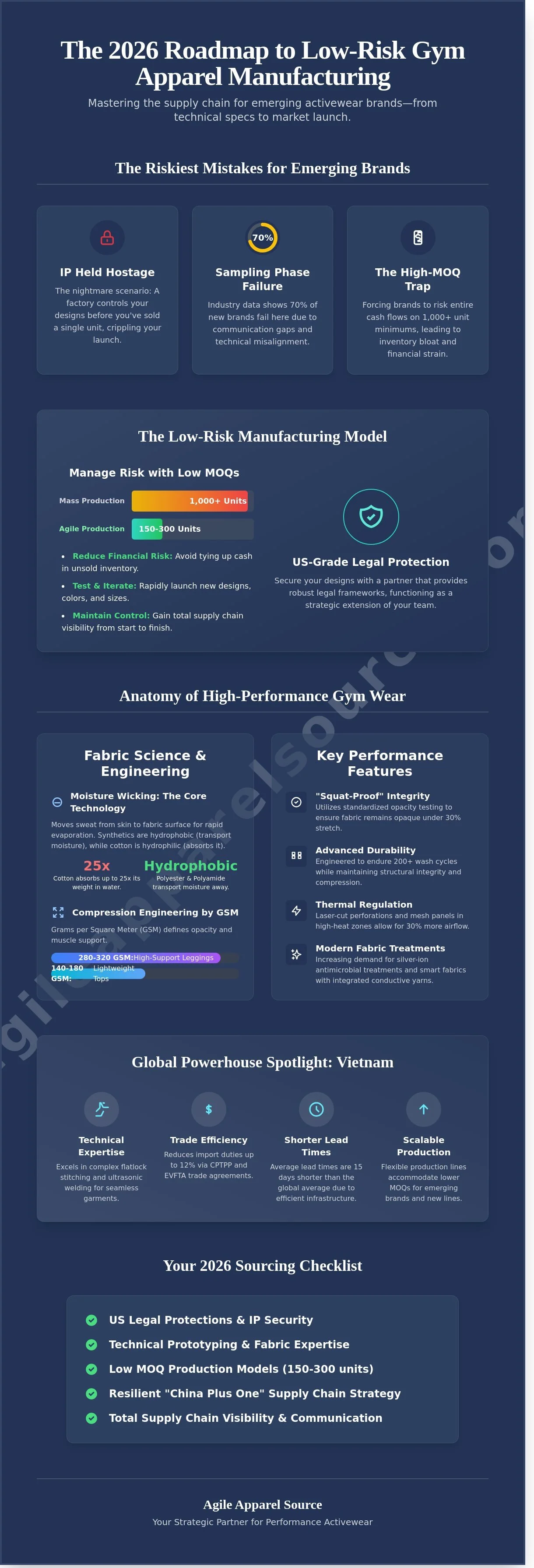
The 2026 Roadmap to Low-Risk Gym Apparel Manufacturing.
Low MOQ vs. Mass Production: Managing Risk for Growing Brands
Traditional manufacturing models often mandate minimum orders of 1,000 units per style. This rigid requirement creates a massive barrier for innovation. It forces brands to commit capital to unproven designs. In contrast, agile gym apparel manufacturers prioritize flexibility through 150 to 300 unit runs. This approach allows you to pivot based on real-time sales data rather than speculative forecasts.
The strategic advantage of smaller orders lies in responsiveness. The fitness market moves fast. Trends in compression fabrics or sustainable recycled polyesters can shift within a single season. High MOQs leave you trapped in old inventory. Low MOQs facilitate a streamlined supply chain where you can launch, learn, and iterate. Key benefits include:
Reduced upfront capital investment for new collections.
Lower risk of inventory obsolescence and "dead stock."
Ability to test multiple colorways and silhouettes simultaneously.
Faster time-to-market for seasonal releases and trend-driven pieces.
The Sweet Spot for Innovation
Testing batches of 150 units prevents the accumulation of unsold goods. According to 2023 retail logistics data, excess inventory can erode profit margins by as much as 30 percent. Agile production improves cash flow by keeping capital liquid for marketing and growth. You can customize private label designs with low-volume silicone printing or embroidery to create "Limited Edition" drops. These exclusive releases drive urgency among fitness influencers. It turns a production constraint into a powerful marketing tool that builds brand heat. By the time a competitor finishes a 90-day mass production cycle, you've already tested and sold through two smaller collections.
Hidden Costs of High-Volume Sourcing
High-volume sourcing often hides systemic costs. You must account for warehousing fees, inventory taxes, and the inevitability of 50 percent clearance markdowns to move stagnant goods. Producing 5,000 units at once increases the risk of "quality drift." This happens when the final 1,000 units don't match the approved gold sample due to factory fatigue or material variation. Small-batch production allows for tighter quality control loops. Partnering with professional gym apparel manufacturers who focus on precision ensures every garment meets technical specifications. Cheap unit prices don't compensate for the long-term brand damage caused by inconsistent quality. If a seam fails on 20 percent of a 10,000-unit order, it's a brand-ending catastrophe.
The 2026 Sourcing Checklist: Vetting Your Gym Wear Partner
Successful production hinges on a vetting process that prioritizes security and technical precision over the lowest possible unit price. In 2026, the gap between high-performing brands and those that fail is defined by the quality of their gym apparel manufacturers. Use this five-step checklist to ensure your supply chain remains resilient and your intellectual property stays protected.
Step 1: Verify the US Legal Bridge. Confirm the factory has a US-based legal entity to ensure contracts are enforceable under domestic law.
Step 2: Technical Prototyping. Assess the speed and accuracy of sample development. A professional partner should convert a tech pack into a physical prototype within 14 days.
Step 3: Audit QC Layers. Look for a documented three-layer system rather than a single final check.
Step 4: Ethical Compliance. Verify WRAP, BSCI, or OEKO-TEX certifications to meet the demands of the 73% of consumers who now prioritize ethical manufacturing.
Step 5: FPP vs. CMT. Determine if the factory offers Full Package Production (FPP) or just Cut, Make, Trim (CMT). For low MOQ lines, FPP is essential as it handles everything from fabric sourcing to final logistics.
Intellectual Property and Legal Security
Blind sourcing on platforms like Alibaba often exposes brands to significant risk. Without an enforceable contract, your proprietary designs and tech packs are vulnerable to being leaked or sold to competitors. A Vietnamese factory with a US-based legal entity acts as a critical safety net. This structure provides a transparent framework for intellectual property protection. It moves the relationship from a risky transaction to a strategic alliance where your designs remain your exclusive property, backed by legal recourse you can actually use.
The Three-Layer Quality Control System
Consistency is the primary challenge when working with gym apparel manufacturers. A robust QC system catches errors before they become expensive mistakes. The first layer is the in-line inspection, which identifies fabric defects or GSM inconsistencies before the cutting process begins. The second layer involves mid-production checks. Here, technicians inspect stitching consistency and seam strength, which is vital for high-compression activewear. The final layer is the pre-shipment audit using AQL (Acceptable Quality Level) 2.5 standards. This rigorous statistical sampling ensures that 98% or more of your batch meets the exact specifications of your original sample.
Ready to secure your production with a partner that understands technical precision? Get a transparent quote for your apparel line today.
Agile Apparel Source: Your Strategic Partner for Performance Activewear
Agile Apparel Source functions as a technical bridge for brands that require the precision of Vietnamese manufacturing without sacrificing the security of US legal standards. Most gym apparel manufacturers operate with a disconnect between design and delivery. We eliminate this friction by acting as your strategic extension. Our Low MOQ solution is a primary differentiator. We offer high-end production starting at just 150 units per style. This allows emerging brands to launch professional-grade collections without the typical 1,000-unit barrier.
Our process relies on digital pattern making to ensure absolute consistency. We move your concept through a streamlined workflow that covers every phase from initial tech pack refinement to global logistics. You get the craftsmanship of a veteran factory with the responsiveness of a modern startup. We don't just take orders; we solve production bottlenecks before they impact your launch date.
FPP for Seamless Scaling
Full Package Production (FPP) is the "easy button" for brand owners who need to focus on marketing rather than micromanaging a supply chain. We handle the complex logistics of fabric sourcing, tech pack creation, and multi-stage sampling within a single ecosystem. Performance activewear is technically demanding. It requires specific moisture-wicking textiles, reinforced flatlock stitching, and high-tensile zippers. We manage these performance trims and custom branding elements to ensure your final product meets professional standards.
For the 2026 production cycle, we've optimized our "Source-to-Shelf" timeline to remain competitive in a fast-moving market. You can expect a standard lead time of 14 to 18 weeks. This window includes 4 to 6 weeks for fabric development and prototype approval, followed by 10 to 12 weeks for bulk manufacturing and ocean freight. This predictability is essential for maintaining seasonal inventory levels and avoiding stockouts during peak fitness cycles.
Your Concept, Our Craftsmanship
We've successfully partnered with fitness brands that began with 150-unit test runs and scaled to 10,000-unit monthly distributions. Our Vietnamese facility is equipped with specialized machinery for heat-sealing and laser-cutting, allowing us to produce garments that rival major global players. You won't be dealing with an anonymous sales rep. The collaborative process involves direct communication with Chris and Thuy. They work with you to refine your vision, ensuring that technical specifications match your aesthetic goals.
This partnership-driven approach is why we're recognized among leading gym apparel manufacturers for reliability. We focus on transparency and ethical production, giving you a story to tell your customers that goes beyond the fabric. We're ready to help you move from a design sketch to a market-ready product.
Ready to build your fitness empire? Contact Agile Apparel Source for a custom quote.
Future-Proof Your 2026 Production Strategy
The 2026 activewear market demands a shift from simple procurement to strategic technical partnerships. Success hinges on your ability to balance high-performance fabric specs with lean inventory management. Selecting the right gym apparel manufacturers isn't just about finding a factory; it's about securing a supply chain that offers both agility and accountability. You need a partner that understands the nuances of compression ratios and moisture-wicking technology while providing the legal security of US-based contracts.
Agile Apparel Source bridges the gap between boutique design and industrial scale. We eliminate traditional barriers to entry by offering low 150-unit MOQs, allowing you to test new performance lines without overextending your capital. Our 3-layer rigorous quality control protocol ensures every shipment meets your exact tech pack specifications before it leaves the floor. By prioritizing transparency and US-based legal protection, we help you navigate the complexities of global sourcing with confidence.
Launch Your Performance Line: Get a Custom Manufacturing Quote
The future of your brand starts with a smarter production model. We're ready to build it with you.
Frequently Asked Questions
What is the standard MOQ for high-quality gym apparel manufacturers?
Standard MOQs for high-quality gym apparel manufacturers typically range from 300 to 500 pieces per style. While some factories offer lower entry points of 100 pieces for specific stock fabrics, 500 units remains the industry benchmark for custom dye lots. This volume ensures production efficiency and maintains a competitive price per unit for growing brands. We find that hitting these targets helps stabilize your supply chain and ensures consistent fabric quality across all sizes.
How long does it take to produce a custom activewear collection?
A custom activewear collection generally requires 12 to 16 weeks for a full production cycle. This timeline includes 4 weeks for sample development and 8 to 12 weeks for bulk manufacturing and quality control inspections. Shipping adds another 3 to 5 weeks depending on whether you choose sea freight or air courier services. Planning your launch around these 120 day cycles is essential for maintaining a consistent inventory flow and meeting seasonal market demands.
What is the difference between FPP and CMT in apparel manufacturing?
FPP (Full Package Production) covers the entire manufacturing process from fabric sourcing to final packaging, while CMT (Cut, Make, Trim) only includes the labor of cutting and sewing your provided materials. Most emerging brands choose FPP because it streamlines the supply chain and reduces logistical errors. CMT requires you to manage fabric suppliers and shipping to the factory independently. This often leads to delays if your textile mill misses a delivery deadline.
Do gym apparel manufacturers provide fabric sourcing services?
Most specialized gym apparel manufacturers provide comprehensive fabric sourcing services as part of their end-to-end production model. Factories typically maintain libraries of 500 or more performance textiles, including moisture-wicking polyesters and high-compression spandex blends. If you require a custom fabric weight or specific knit pattern, manufacturers can coordinate with textile mills to develop bespoke materials. This integrated approach removes the burden of supply chain management from your design team.
How can I protect my clothing designs when manufacturing overseas?
You can protect your clothing designs by signing a bilingual Non-Disclosure Agreement (NDA) and registering your intellectual property in the manufacturing country. In Vietnam, the Law on Intellectual Property 2005 provides the legal framework for protecting industrial designs and trademarks. Working with established partners who value transparency ensures your proprietary patterns and tech packs remain secure throughout the manufacturing process. We recommend verifying a factory's business license and export history before sharing sensitive design files.
Why is Vietnam considered better than China for athletic wear?
Vietnam is often preferred over China for athletic wear because of its lower import tariffs and specialized expertise in technical synthetic fabrics. Under the EVFTA and CPTPP trade agreements, Vietnam offers significant duty-free advantages to European and Pacific markets. Recent industry data shows Vietnam's garment exports grew by 14.7 percent in 2022, reflecting its rising status as a hub for high-performance apparel. These trade benefits directly impact your bottom line by reducing landed costs.
Can I manufacture gym clothes with sustainable or recycled fabrics?
You can manufacture gym clothes using GRS-certified (Global Recycled Standard) recycled polyester or organic cotton blends. These sustainable options now account for approximately 25 percent of performance fabric requests in the activewear sector. Utilizing recycled nylon, often sourced from reclaimed fishing nets or post-industrial waste, allows your brand to meet modern ethical standards without sacrificing technical performance. We help you source these materials from certified mills to ensure full traceability throughout your supply chain.
What technical documents (Tech Packs) do I need to start production?
You need a comprehensive Tech Pack that includes detailed CAD drawings, a Bill of Materials (BOM), and a full size specification chart. This document acts as your production blueprint, ensuring the factory achieves 100 percent accuracy during the sampling phase. Without these technical documents, manufacturers cannot provide a precise quote or guarantee the fit consistency of your activewear line. Providing clear construction notes and stitch requirements prevents costly errors during the bulk production stage.
As a leading sourcing agent in Vietnam, Agile Apparel Source helps you choose the right high-performance fabrics for your collection. Contact us for a technical consultation. Ready to start your collection?Click here to get a Low MOQ quote.
