
The Best Yoga Pant Material: A Manufacturer’s Guide to High-Performance Fabrics.
What if the "premium" label on your fabric is the exact reason your latest production run is failing the squat test? You know that a single batch of translucent leggings can dismantle a brand's reputation faster than a viral campaign can build it. Consistency in your yoga pant material is the backbone of customer loyalty, yet industry data suggests that up to 40% of activewear returns are driven by transparency and pilling issues. We're here to solve that volatility by providing the technical precision your design team requires.
This guide helps you master the differences between nylon and polyester blends to ensure your next collection is both squat-proof and durable. You'll gain a clear framework for selecting specific GSM targets, typically ranging from 280 to 320 for high-compression performance, and understanding how interlock knits provide the necessary opacity. We'll outline a streamlined process for communicating these technical requirements to overseas factories, ensuring your tech packs translate into flawless production. By the end of this article, you'll have a strategic roadmap to source fabrics that truly define your brand’s performance and long-term scalability.
Key Takeaways
- Identify the 2026 technical benchmarks for premium activewear, focusing on 4-way stretch and moisture management to ensure absolute squat-proof opacity.
- Compare the technical performance of Nylon-6,6 against polyester to determine the ideal yoga pant material for your next high-performance collection.
- Decode manufacturer spec sheets by understanding how GSM and interlock knit structures dictate the seasonal weight and durability of your garments.
- Leverage the "Vietnam Advantage" to optimize your supply chain and implement a resilient "China Plus One" sourcing strategy for technical apparel.
- Streamline your production through Full Package Production (FPP) solutions that manage everything from technical fabric sourcing to precise color accuracy.
Table of Contents
- What Defines a Premium Yoga Pant Material in 2026?
- Nylon vs. Polyester: The Technical Showdown
- The Manufacturer’s Spec Sheet: GSM, Knit, and Finish
- Sourcing Strategy: The Vietnam Advantage for Activewear
- Launch Your Yoga Line with Agile Apparel Source
What Defines a Premium Yoga Pant Material in 2026?
In the 2026 activewear market, a high-quality yoga pant material must satisfy three core technical demands: 4-way stretch, moisture management, and total opacity. Brands that fail to meet these benchmarks face high return rates and damaged reputations in an increasingly discerning market. The industry gold standard has shifted from simple cotton blends to complex high-performance fabrics that provide targeted muscular compression and thermal regulation. We see a clear divide between "hand-feel," which focuses on immediate tactile softness, and "technical performance," which ensures the garment functions under stress.
The "squat test" remains the ultimate metric for technical validation in the production cycle. If a fabric thins or becomes translucent under 30% elongation, it fails the quality control requirements for professional-grade gear. While casual athleisure fabrics prioritize comfort for lounging, performance textiles are engineered for high-intensity movement. This distinction is critical for sourcing teams. Choosing a fabric based on softness alone often leads to structural failure during a workout, whereas a technical textile maintains its integrity through every transition.
The Four Pillars of High-Performance Leggings
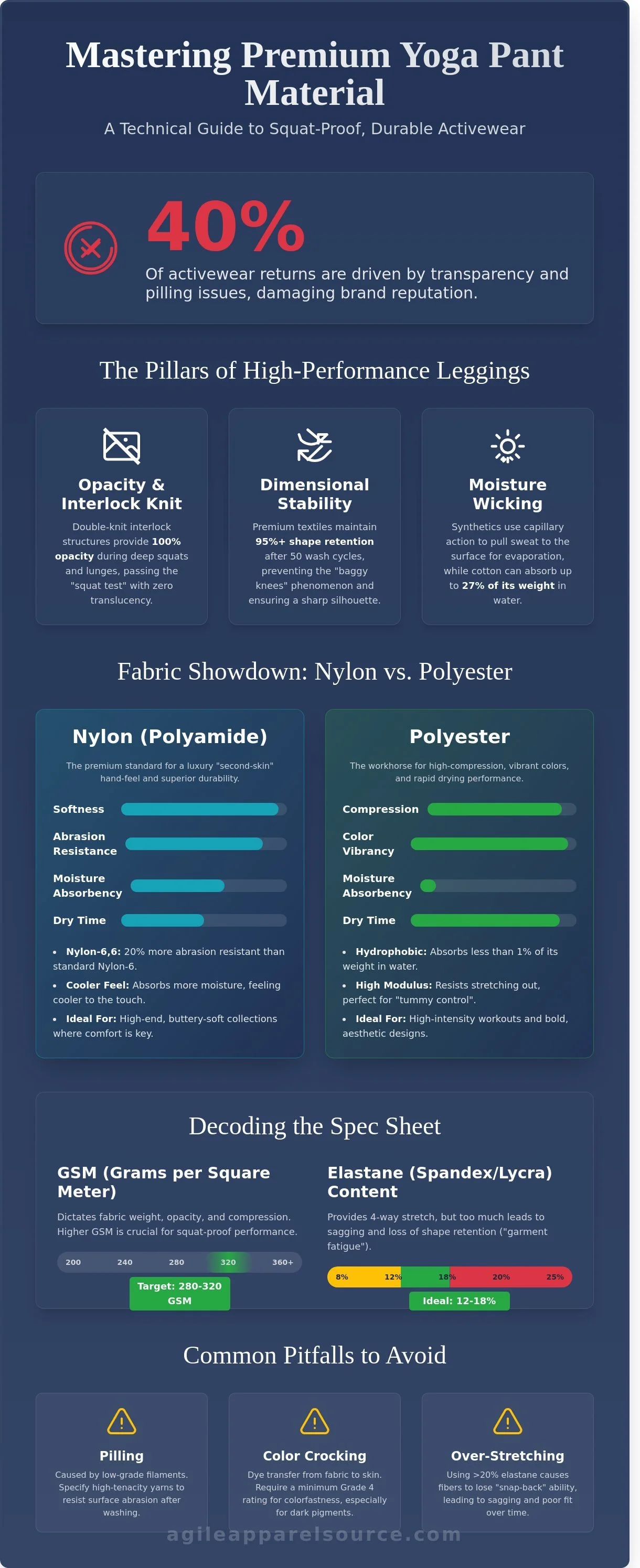
- Dimensional Stability: This prevents the "baggy knees" phenomenon. Premium textiles maintain 95% or higher shape retention even after 50 wash cycles, ensuring the silhouette remains sharp.
- Moisture-Wicking vs. Absorption: Synthetic fibers like nylon and polyester use capillary action to pull sweat to the surface for evaporation. In contrast, natural fibers like cotton can increase garment weight by up to 27% when wet, hindering the athlete.
- Opacity and Interlock Knit: We utilize double-knit interlock structures to achieve high density without adding excessive weight. This construction technique ensures 100% opacity during deep lunges and squats.
Common Pitfalls in Material Selection
The "pilling" problem is a frequent failure point in yoga pant material selection. Lower-grade polyester blends often show surface abrasion after just three washes. To prevent this, we specify high-tenacity filaments that resist friction. Colorfastness is another challenge, specifically "crocking" in deep pigments like navy and black. We require a minimum Grade 4 rating on the grayscale for color transfer to ensure dyes don't bleed onto skin or other clothing.
Over-stretching is a hidden risk in fabric engineering. While stretch is necessary, using more than 20% Spandex or Lycra often leads to garment fatigue. When the elastic fibers are over-extended, they lose their "snap-back" ability, causing the leggings to sag. The ideal balance for performance gear typically sits between 12% and 18% elastane content, providing sufficient flex without compromising the garment's lifespan.
Nylon vs. Polyester: The Technical Showdown
Selecting the right yoga pant material depends on whether you prioritize luxury hand-feel or technical performance. Most high-performance leggings utilize a 75/25 or 80/20 blend of synthetic fibers and Spandex. These ratios provide the necessary 4-way stretch while maintaining the garment's structural integrity. While both Nylon and Polyester serve as the foundation for activewear, their molecular structures dictate how they perform during a workout.
Nylon: The Premium Standard for Softness and Strength
Nylon, specifically Polyamide, remains the gold standard for high-end yoga collections. Nylon-6,6 fibers provide 20% more abrasion resistance than standard Nylon-6, making them ideal for high-friction zones. This fabric feels cooler to the touch because it absorbs moisture more effectively than polyester, mimicking the comfort of natural fibers without the heavy weight of cotton. Many brands source these premium blends from Vietnam’s technical mills, which have invested heavily in advanced knitting machinery to produce "buttery soft" textures that don't pill. It's the preferred choice for "second-skin" designs where comfort is the primary selling point.
Polyester: The King of Compression and Color
Polyester is the workhorse of the activewear industry. It's the most effective yoga pant material for high-compression "tummy control" designs because the fibers have a higher modulus, meaning they resist stretching out over time. Polyester is naturally hydrophobic; it absorbs less than 1% of its weight in water. This allows the fabric to dry almost instantly. For brands focused on aesthetics, polyester is essential for vibrant, permanent digital prints. Sublimation printing requires the high-heat tolerance of polyester to fuse dyes directly into the fiber, ensuring patterns don't fade or "white out" when the fabric stretches.
Sustainable Alternatives: Recycled Nylon and Polyester
The industry is moving rapidly toward circularity. GRS-certified Recycled Polyester (rPET), often sourced from post-consumer plastic bottles, now matches the performance of virgin fibers while reducing energy consumption by 45% during production. Recycled nylon is also gaining traction, though the chemical recycling process is more complex. To further enhance eco-credentials, manufacturers are integrating bio-based Elastane, which replaces petroleum-based components with renewable plant sources. You can partner with a specialized sourcing team to verify these certifications and ensure your sustainable line meets the same rigorous "squat-proof" standards as traditional materials. Marketing these fabrics requires transparency, but the data shows that 60% of modern consumers are willing to pay a premium for verified sustainable activewear.
- Nylon: Best for luxury feel, softness, and durability in high-friction areas.
- Polyester: Best for compression, moisture-wicking speed, and vivid sublimation prints.
- Blends: 75/25 or 80/20 ratios with Lycra provide the industry-standard stretch and recovery.
Choosing between these two depends on your target price point and your customer's specific needs. Nylon-based products typically command a higher retail price, while polyester allows for greater scalability and design versatility.
Mastering Premium Yoga Pant Material.
The Manufacturer’s Spec Sheet: GSM, Knit, and Finish
Selecting the right yoga pant material requires a deep dive into technical specifications. Performance isn't accidental; it's engineered through precise measurements of weight, structure, and surface treatment. Manufacturers rely on these metrics to ensure consistency across production runs and meet the high expectations of the activewear market.
Understanding GSM for Different Yoga Styles
GSM stands for Grams per Square Meter. This metric defines the fabric's density and directly impacts its seasonal utility. Choosing the wrong GSM can result in leggings that are either too sheer or uncomfortably hot for the intended activity.
Lightweight (180-220 GSM): These fabrics provide a "naked feel" and are optimized for hot yoga or high-intensity interval training. They prioritize breathability and moisture-wicking over high compression.
Mid-weight (240-280 GSM): This range represents the 75% market majority for all-purpose leggings. It offers a reliable balance of opacity and flexibility for daily wear.
Heavyweight (300+ GSM): Ideal for winter-ready thermal wear. These materials provide maximum compression and are often used in high-waisted performance gear to offer extra muscular support.
Knit Structures: Interlock vs. Circular Knit
The internal architecture of the fabric determines how it moves with the body. Interlock knit is a double-knit construction that creates a smooth surface on both sides. This structure is the industry standard for squat-proof leggings because the double layer prevents the fabric from becoming transparent when stretched to its limit.
While circular knitting offers excellent 360-degree stretch, warp knitting provides superior resistance to laddering. If a thread breaks in a warp-knit garment, the fabric won't unravel easily. Manufacturers often select yarn counts, or denier, based on these structures. A higher denier, such as 70D or 100D, increases durability and opacity, while lower counts like 40D create a more delicate, draping effect on the body.
Functional Finishes and Coatings
The final stage of production involves applying finishes that alter the fabric's performance or hand-feel. Mechanical brushing is the process used to create "buttery soft" textures. Metal rollers with fine wire teeth gently raise the fibers on the fabric surface, creating a peach-skin effect that feels soft against the skin.
Chemical treatments add functional value. Silver Ion antimicrobial treatments reduce odor-causing bacteria by up to 99% during sweaty sessions. For outdoor activewear, manufacturers apply Durable Water Repellent (DWR) coatings. These finishes ensure the yoga pant material remains dry and functional in diverse environments, moving beyond the studio to the trail.
Sourcing Strategy: The Vietnam Advantage for Activewear
Vietnam has solidified its position as the premier global hub for technical activewear. In 2023, Vietnam's textile and garment exports reached approximately $40 billion, driven by massive investments in synthetic knitting infrastructure and specialized machinery. Many brands now adopt a "China Plus One" strategy to mitigate geopolitical risks and diversify their supply chains. This shift isn't just about risk; it's about accessing a workforce specifically trained in the complexities of high-stretch sewing.
Agile Apparel Source bridges the gap between US design teams and Vietnamese production floors. Our US-based management team acts as a technical translator, ensuring that your specific yoga pant material requirements are understood and executed. This communication relies heavily on the Tech Pack. A precise Tech Pack eliminates ambiguity by detailing fiber blends, GSM (grams per square meter), and stretch recovery percentages. Without this blueprint, technical fabrics often fail to meet performance expectations during the assembly phase.
Overcoming High MOQs for Technical Fabrics
Traditional technical fabric mills often demand 3,000 yards per color, which creates a significant barrier for growing brands. We solve this by facilitating low MOQ manufacturing starting at just 150 units per style. Our strategy involves two primary paths:
Available-Market Sourcing: We tap into high-end "stock" fabrics that meet professional performance standards without custom lead times.
Fabric Remnants: Our sourcing agents identify premium remnants from Tier 1 factory overages, allowing small batches to utilize the same elite textiles as global athletic giants.
Quality Control in Textile Sourcing
Quality begins at the roll, not the finished garment. We utilize a strict 4-point inspection system to evaluate every yard of yoga pant material before it hits the cutting table. This system assigns points based on the size and severity of defects, ensuring only top-grade textiles move forward. Beyond visual checks, we prioritize two critical technical tests:
Torque and Skew Testing: We measure the grainline alignment to ensure your leggings don't twist or rotate around the leg after the first wash.
Elongation and Recovery: We verify that the fabric returns to its original shape, preventing the "baggy knee" syndrome common in low-quality knits.
Sourcing abroad can feel risky, but our model provides US legal protection and domestic accountability. You get the cost efficiencies of Vietnamese production with the security of a US business partnership. This setup allows you to focus on design while we handle the logistical heavy lifting.
Ready to streamline your production? Partner with Agile Apparel Source to access elite Vietnamese manufacturing with low minimums.
Launch Your Yoga Line with Agile Apparel Source
Selecting the ideal yoga pant material is a critical first step, but transforming that fabric into a market-ready product requires a sophisticated manufacturing partner. We provide Full Package Production (FPP) services specifically designed for activewear brands that need to scale without the typical headaches of global sourcing. Our team manages every technical detail, from initial fabric sourcing to the final logistics of bulk shipping. This comprehensive approach allows designers to focus on their creative vision while we handle the complexities of the supply chain.
Precision is mandatory in performance apparel. We utilize a rigorous lab dip process to ensure color accuracy across different lighting conditions; this guarantees that your seasonal palettes remain consistent from sample to shelf. By combining our strategic headquarters in Kalispell, MT with high-level craftsmanship in Vietnam, we offer a unique hybrid model. You get the benefit of local, responsive communication alongside the technical expertise and cost efficiencies of a premier global manufacturing hub.
Why Brands Choose Our Activewear Solutions
Quality control in activewear cannot be an afterthought. We implement a "Three-Layer" QC system that monitors production at the raw material stage, during the sewing process, and through a final 100 percent inspection before packing. This ensures that every pair of leggings meets high-performance standards for stretch, recovery, and seam strength. Agile Apparel Source acts as the ultimate fixer for brands, resolving production bottlenecks and ensuring that technical specifications are met exactly as written in your Tech Pack.
End-to-end support starting from initial sample development.
Low MOQ production runs that allow for agile market testing.
Streamlined Tech Pack creation to eliminate manufacturing errors.
Transparent logistics and supply chain optimization.
Get Started with Your Fabric Selection
Success in the 2026 activewear market requires early planning. Most brands are currently finalizing their 2026 collections at least 8 months in advance to secure textile allocations and production slots. You can begin by requesting a curated fabric swatch kit or initiating a single sample order to test specific blends. This proactive approach ensures your yoga pant material performs under pressure and reaches consumers exactly when planned. Ready to source the perfect yoga pant material? Contact us today.
Scale Your Brand with Technical Precision
Choosing the optimal yoga pant material for 2026 requires a data-driven approach to GSM, knit structure, and moisture-wicking finishes. High-performance nylon and polyester blends remain the primary choice for durability, but the true competitive edge comes from sourcing strategy. Leveraging Vietnam's specialized manufacturing hubs provides the technical infrastructure necessary for the premium activewear market. This regional expertise ensures your garments meet the specific AATCC stretch and recovery benchmarks required by athletes across the globe.
Agile Apparel Source acts as your strategic partner to simplify these complex manufacturing decisions. We offer US-based legal security and deep expertise in technical activewear sourcing to protect your interests abroad. You'll benefit from a streamlined supply chain that eliminates traditional production headaches. By offering low MOQs starting at 150 units, we make it possible to test new designs without the burden of excessive inventory. Our team handles the end-to-end logistics so you can focus on growing your brand. It's time to transform your technical concepts into market-ready products with a partner that values precision.
Start Your Activewear Production with Low MOQs today. Your path to a scalable activewear line begins here.
Frequently Asked Questions
Is Nylon or Polyester better for yoga pants?
Nylon outperforms polyester in softness and abrasion resistance, making it the superior choice for premium activewear. A 2023 industry analysis shows nylon 6,6 offers 20 percent higher tensile strength than standard polyester. While polyester provides excellent color retention for sublimation, nylon is the preferred yoga pant material for brands prioritizing a luxury hand-feel and long-term durability during high-intensity movement.
How do I know if a yoga pant material is squat-proof?
You determine if a fabric is squat-proof by verifying the fabric weight and the specific knit construction. A minimum weight of 250 GSM prevents transparency when the fibers are fully extended. We recommend using a double-knit interlock construction. This technique ensures the textile remains opaque even when stretched to its 300 percent elastic limit during deep movements.
What does GSM mean in leggings?
GSM stands for Grams per Square Meter and serves as the standard metric for fabric weight. For professional leggings, a GSM range between 220 and 320 is the industry benchmark. Fabrics at 180 GSM are often too thin for standalone bottoms, while a 300 GSM yoga pant material provides the necessary compression and coverage that athletes expect from high-performance gear.
Can I manufacture high-quality yoga pants with low MOQs?
You can manufacture premium yoga pants with low Minimum Order Quantities by utilizing agile stock fabric programs. Many specialized manufacturers now offer MOQs starting at 50 units per style by sourcing from pre-certified fabric rolls. This approach reduces your initial capital risk and shortens production lead times by approximately 30 days compared to custom-dye orders.
What is the most sustainable material for activewear?
Recycled nylon and recycled polyester are the most effective sustainable options for high-performance apparel. According to the 2022 Textile Exchange report, recycled polyester reduces CO2 emissions by 32 percent compared to virgin alternatives. Brands also adopt Tencel Lyocell, which utilizes a closed-loop manufacturing process to recover 99 percent of the solvents used during fiber production.
Why is Vietnam a good place to source yoga pants?
Vietnam is a primary sourcing hub because of its sophisticated technical infrastructure and favorable trade agreements like the CPTPP. The country's garment exports reached 44 billion USD in 2022, showcasing its massive production capacity. Manufacturers in this region specialize in complex synthetic blends and high-precision bonding techniques that meet the strict quality requirements of global Tier-1 brands.
What is the difference between Spandex, Lycra, and Elastane?
These terms describe the same elastic fiber, but Lycra is a trademarked brand name owned by The Lycra Company. Elastane is the technical term used in Europe, while Spandex is the common name used in North American markets. All three provide the essential 4-way stretch required for yoga garments, typically comprising 15 to 25 percent of the total fabric blend.
How do I prevent my yoga pants from pilling?
You prevent pilling by selecting long-staple fibers and applying specialized anti-pilling finishes during the textile finishing stage. Fabrics that achieve a Grade 4 or higher on the Martindale Abrasion Test demonstrate superior resistance to surface wear. Using air-jet spun yarns rather than ring-spun yarns also reduces the likelihood of pilling by 30 percent over the garment's lifecycle.
As a leading sourcing agent in Vietnam, Agile Apparel Source helps you choose the right high-performance fabrics for your collection. Contact us for a technical consultation. Ready to start your collection? Click here to get a Low MOQ quote.
