
The Founder’s Guide to Low MOQ Manufacturing in 2026: Balancing Scale and Agility
Why would an ambitious founder gamble their entire seed round on a 5,000-unit minimum when consumer trends shift in less than 21 days? The traditional requirement for massive upfront volume is no longer a prerequisite for quality; it's a liability that drains liquidity and stifles innovation. You likely recognize that tying up capital in stagnant warehouse stock is a strategic error, yet the fear of inconsistent stitching or intellectual property theft often keeps you tethered to legacy factories. Mastering low moq manufacturing in 2026 is about more than just surviving. It's about building a responsive brand that scales without the 30% inventory waste typical of bulk-first models.
This guide provides a technical roadmap to leveraging agile production to launch high-end apparel lines without inventory risk or quality compromises. We'll examine how to vet overseas partners for transparency and implement tech packs that ensure precision in small-batch runs. You'll learn to transform your supply chain into a dynamic asset that prioritizes speed to market and protects your bottom line through every phase of growth.
Key Takeaways
- Identify why the 150-unit threshold is the strategic "sweet spot" for high-end labels to maximize cash flow without sacrificing craftsmanship.
- Evaluate the shift toward Vietnam as the primary hub for premium apparel and how a "China Plus One" strategy stabilizes your global supply chain.
- Navigate the complexities of low moq manufacturing to launch new collections with minimal inventory risk and maximum market responsiveness.
- Master the factory "interview" process by preparing professional-grade Tech Packs that secure production slots with top-tier manufacturers.
- Protect your brand’s intellectual property by bridging the gap between global production and US-based legal security.
Table of Contents
- Understanding Low MOQ Manufacturing in the 2026 Fashion Landscape
- Vietnam: The Strategic Hub for Low MOQ High-End Apparel
- Domestic vs. Overseas: Finding Your Manufacturing Sweet Spot
- Preparing for Production: How to Get Accepted by Low MOQ Factories
- Agile Apparel Source: US Legal Security Meets Global Craftsmanship
Understanding Low MOQ Manufacturing in the 2026 Fashion Landscape
Minimum Order Quantity (MOQ) represents the lowest number of units a factory accepts for a single style or colorway. In the 2026 fashion market, low moq manufacturing has evolved from a niche service into a core strategic lever for capital efficiency. Traditional manufacturing models often demand 500 to 1,000 units per style, which traps approximately 65% of a startup's liquid capital in physical inventory before a single sale occurs. By reducing these thresholds, founders can maintain a leaner balance sheet and allocate more resources toward customer acquisition and brand development.
The industry has identified 150 units as the strategic sweet spot for mid-to-high-end fashion labels. This volume is significant enough to secure professional-grade finishing and competitive material sourcing, yet small enough to sell through within a standard 6-week retail window. This shift supports the move toward agile, drop-based inventory models. Instead of two massive seasonal launches, successful 2026 brands now utilize 8 to 12 smaller "drops" throughout the year. This strategy minimizes deadstock waste, which currently accounts for 30% of global garment production, and ensures that every piece manufactured has a clear path to a customer's wardrobe.
The Economic Reality of Small Batch Production
Factories set MOQs based on technical constraints like machine setup times and fabric mill requirements. Standard industrial dye vats often require 300 meters of fabric to operate efficiently. Small batch production bypasses these hurdles by utilizing stock fabrics or advanced digital printing technologies. Brands must analyze their [Economic Order Quantity (EOQ)]5 to determine the precise point where the cost of carrying inventory outweighs the savings of a lower per-unit price. Low moq manufacturing empowers brands to reallocate resources toward trending silhouettes within a 45-day production cycle when initial consumer feedback indicates a shift in demand.
Who Benefits Most from Low MOQ Solutions?
- Emerging Luxury Designers: These founders can test high-concept, $500+ price point items with 50-unit runs to gauge market appetite without overextending their production budget.
- Established Brands: Large retailers use low MOQs to launch limited-edition capsule collections or "collabs" that drive brand heat without the risk of heavy markdowns.
- E-commerce Startups: These businesses follow a "test and scale" methodology, identifying high-performing SKUs through small initial batches before committing to 1,000-unit reorders.
Adopting a low MOQ approach isn't just about smaller numbers. It's about building a responsive supply chain that prioritizes market data over guesswork. This precision allows founders to scale their operations sustainably, ensuring that growth is driven by actual demand rather than inventory speculation.
Vietnam: The Strategic Hub for Low MOQ High-End Apparel
Vietnam has evolved into the primary destination for brands prioritizing precision over sheer volume. While China remains the world's largest exporter, Vietnam's apparel sector grew by 6.4% in 2022, reaching a total export value of $37.5 billion. This growth isn't just about capacity; it's about a fundamental shift toward mid-to-high-end garment construction. Founders now look to Vietnamese facilities to execute complex designs that require a level of hand-finishing and technical oversight that mass-market hubs often ignore.
Craftsmanship and Technical Capability
High-complexity categories like technical activewear and performance swimwear require specialized machinery and a highly trained workforce. Vietnamese factories have invested heavily in bonding, laser cutting, and ultrasonic welding technologies. These tools are essential for modern apparel but require skilled operators to manage effectively. Industry data from 2023 shows that Vietnam now accounts for over 15% of global high-end activewear production. This expertise ensures that low moq manufacturing doesn't result in a drop in quality. Skilled artisans in these hubs handle smaller batches with the same rigor applied to large-scale runs, maintaining stitch consistency and seam strength across every unit.
The China Plus One Advantage
Adopting a China Plus One strategy is no longer optional for brands seeking long-term stability. Diversifying production into Vietnam reduces exposure to geopolitical shifts and avoids the 25% tariffs often levied on Chinese-made goods. This geographic shift doesn't mean losing access to quality components. Vietnam's proximity to southern Chinese textile hubs allows for the rapid transit of premium raw materials and trims, often arriving at the factory in under 5 days. Most importantly, Vietnamese partners are more culturally aligned with the needs of emerging labels. While Tier 1 Chinese factories often demand minimums of 3,000 units, many Vietnamese facilities have optimized their lines for low moq manufacturing, accepting orders as low as 100 to 300 units per style. This flexibility allows you to partner with a sourcing expert to test new collections without the burden of excessive inventory.
Sustainability is a core driver of the Vietnamese manufacturing identity. The country saw a 30% increase in LEED-certified garment facilities between 2020 and 2023, reflecting a national commitment to ethical production. These factories utilize solar energy and advanced water filtration systems to meet the strict compliance standards of Western markets. Logistics also favor this region. Sea freight from Ho Chi Minh City to major Western ports typically spans 21 to 35 days. By utilizing these established trade routes and high-tech facilities, brands can achieve a streamlined, responsive supply chain that prioritizes both ethics and efficiency.
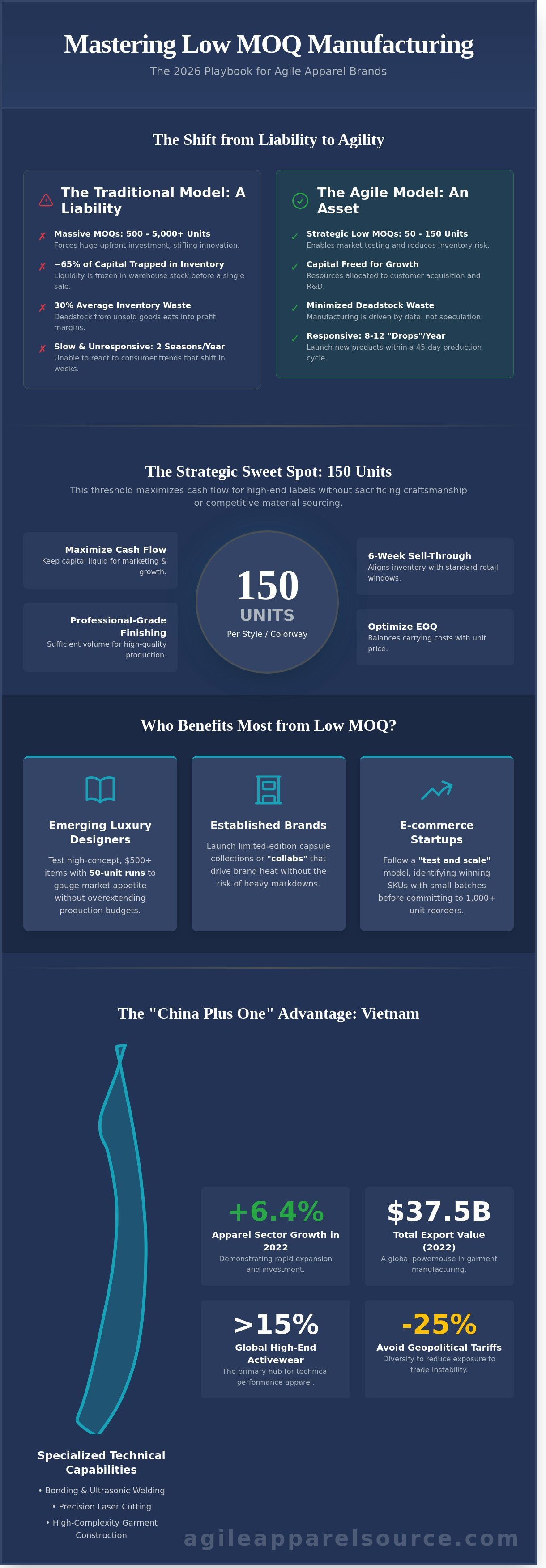
Mastering Low MOQs Manufacturing
Domestic vs. Overseas: Finding Your Manufacturing Sweet Spot
Choosing between domestic and overseas production is a strategic calculation rather than a simple binary choice. US-based manufacturing offers a rapid 2-week turnaround but often results in a cost per unit that's 3x to 5x higher than international alternatives. In contrast, Vietnam provides a sophisticated textile infrastructure that reduces the cost of goods sold (COGS) by 40% or more, even after accounting for international logistics. For a founder, the goal is to balance these margins against the need for speed.
The total landed cost of low moq manufacturing involves several variables that many first-time founders overlook. You must calculate more than just the factory quote. Consider these factors:
- Tariffs and Duties: While Section 301 tariffs have impacted China-based sourcing, Vietnam remains a competitive alternative with favorable duty rates on many apparel categories.
- Shipping Logistics: Air freight for a 150-unit test run typically consumes 12% to 15% of the total production budget but cuts transit time from 30 days to 5 days.
- Quality Assurance: Domestic proximity allows for easier site visits, but a structured overseas process can achieve the same results at a fraction of the labor cost.
Scalability is the final piece of the puzzle. Low MOQ manufacturing serves as your proof of concept. If a 150-unit pilot sells out in 72 hours, a US-based micro-factory might hit a labor wall and struggle to scale. A Vietnamese partner with 500+ sewing lines can transition your brand from a small test to a 5,000-unit replenishment cycle without requiring you to switch vendors or re-develop your tech packs.
The Quality Control Gap
Traditional factories often view small batches as "filler" work, which can lead to defect rates as high as 8% in low moq manufacturing. We eliminate this risk using a three-layer quality control system. This includes an initial factory-level check, an independent agency audit, and a final pre-shipment gate. This rigorous process ensures that a medium-sized garment in navy matches the large-sized garment in the same colorway perfectly, maintaining brand integrity across every SKU.
Communication and Time Zone Management
Managing a factory 8,000 miles away creates a 12-hour communication lag that can stall production cycles. Solo founders often find themselves on WhatsApp at 2:00 AM trying to resolve technical issues. A US-based partner acts as a localized command center, bridging this gap. We handle the technical dialogue with Vietnam-based teams overnight and provide streamlined status updates by 9:00 AM EST. Our team uses real-time production tracking tools to ensure 100% transparency from the first stitch to the final delivery.
Preparing for Production: How to Get Accepted by Low MOQ Factories
Factories view small orders as high-risk, low-margin commitments. They often interview brands to filter out those who aren't ready for the rigors of the factory floor. To secure a spot in a high-quality facility, you must demonstrate professional readiness through technical documentation and a clear understanding of the supply chain. If you enter negotiations without a technical foundation, most reputable manufacturers will prioritize larger, more organized clients.
Success in low moq manufacturing depends on your ability to minimize friction for the factory. This means providing everything they need to start immediately. You'll need to decide between custom milling and stock fabrics early on. Custom milling typically requires 1,000 meters or more per color, which is rarely feasible for small runs. Most agile brands utilize stock fabrics, which are high-quality materials already held in inventory by the mill. This choice reduces fabric lead times from 8 weeks down to 1 week, allowing your production to move much faster.
The Tech Pack: Your Manufacturing Blueprint
A professional Tech Pack is the only way to ensure your vision translates accurately to the finished garment. It acts as a comprehensive instruction manual, containing the Bill of Materials (BOM), graded measurement charts, and specific construction details like stitch types and seam allowances. Without these details, factories are forced to guess, leading to a 40% increase in production errors. A tech pack is a legally binding quality standard for the factory. It provides the objective criteria needed to hold a manufacturer accountable if the final product doesn't meet your specifications.
The Sampling and Prototyping Phase
Budget for at least 2 or 3 rounds of fit samples before you start the actual run. Each round is an opportunity to refine the silhouette and verify that the fabric performs as expected. The most critical milestone is the Pre-Production (PP) sample. This is the final version of the garment, produced using the exact fabric, trims, and labels intended for the bulk order. In low moq manufacturing, the PP sample serves as the "golden sample" that stays on the factory floor as a reference point for quality control. Managing your feedback loops with 48-hour response times ensures that you don't lose your production slot in the factory's busy schedule.
Ready to move from concept to shelf with a team that prioritizes your growth? Explore our professional production management services to get started today.
Agile Apparel Source: US Legal Security Meets Global Craftsmanship
Agile Apparel Source acts as a strategic bridge between American design houses and Vietnam's premier manufacturing facilities. We eliminate the friction often found in overseas production by providing local accountability and professional oversight. Our model focuses on results, ensuring that every project meets rigorous quality standards while maintaining the speed required by modern fashion cycles. We don't just facilitate transactions; we build production infrastructures that allow founders to focus on brand growth rather than logistical headaches.
Protecting Your Brand’s Intellectual Property
Intellectual property theft remains a critical concern for emerging labels. Overseas manufacturing often carries the risk of "ghost production," where factories produce unauthorized units using your proprietary patterns to sell on gray markets. We mitigate this risk through US-based legal contracts. By operating under US jurisdiction, we offer enforceable IP protection that standard overseas vendors can't provide. This legal shield ensures your designs, trade secrets, and brand equity remain secure throughout the manufacturing lifecycle.
Our commitment to transparency extends to our ethical standards. We vet every facility for fair labor practices and safe working conditions. We prioritize a clean supply chain that aligns with modern ESG requirements, moving beyond simple manufacturing to strategic value creation. You can trust that your garments are produced in environments that respect both the craft and the creator.
Comprehensive Sourcing and Logistics
We offer both Full Package Production (FPP) and Cut, Make, Trim (CMT) services to suit your brand's specific operational maturity. Our FPP model is an end-to-end solution where we manage the entire source-to-shelf arc, including fabric sourcing, tech pack review, and final delivery. For brands with established textile relationships, our CMT service focuses on precision assembly and finishing. Our technical expertise covers several high-demand categories:
- Streetwear: High-gsm heavyweights and custom-dyed textiles.
- Activewear: Performance fabrics with advanced moisture-wicking technology.
- Swimwear: Technical materials featuring chlorine resistance and four-way stretch.
We specialize in low moq manufacturing, with minimums starting at just 150 units per style. This flexibility allows you to test market viability without heavy capital expenditure. As your brand gains traction, our infrastructure supports a seamless transition into bulk production of 5,000 or 10,000 units. We handle the complexities of customs clearance and international freight, ensuring your inventory arrives on time and ready for retail. Ready to scale? Request a quote today to begin your production journey with a partner that understands the speed of the industry.
Future-Proof Your Supply Chain for 2026
Success in the 2026 fashion market requires a fundamental shift from mass production to precision-based agility. Founders who prioritize leaner inventories and responsive supply chains are better positioned to capture emerging trends without the burden of unsold stock. By utilizing Vietnam's specialized manufacturing hubs and maintaining professional tech pack standards, brands can secure the quality they need at a fraction of the traditional risk. Navigating this transition means finding a partner that understands the technical demands of low moq manufacturing while providing the safety of a domestic business structure.
Agile Apparel Source delivers this balance by combining US-based legal security with world-class production expertise. Our team handles the complexities of high-end activewear and streetwear production, offering accessible entry points with MOQs starting at 150 units. We don't just act as a vendor; we function as a strategic extension of your design team. It's time to stop fighting outdated manufacturing hurdles and start building a scalable, transparent production model that supports your brand's growth. The tools for global scale are now within reach for emerging labels.
Start your low MOQ production journey with Agile Apparel Source today
Frequently Asked Questions
What is considered a low MOQ in the apparel industry?
A low MOQ in the apparel industry typically ranges between 50 and 300 units per style. While traditional mass-market factories often demand minimums of 1,000 units or more, low moq manufacturing allows emerging brands to test markets without heavy inventory risk. This threshold varies by garment complexity; basic t-shirts might sit at 100 units while technical outerwear requires 300 units due to specialized machinery requirements.
Is it more expensive to produce small batches than bulk orders?
Yes, the price per unit is generally 20% to 40% higher for small batches compared to bulk orders of 5,000 units. This price gap stems from fixed costs like pattern making, machine setup times, and fabric wastage that remain constant regardless of volume. You're trading a higher unit cost for reduced inventory overhead and faster capital turnover, which protects your cash flow during early growth phases.
Do I need a tech pack for low MOQ manufacturing?
You absolutely need a comprehensive tech pack for every production run, regardless of the order size. A tech pack acts as the blueprint for your garment, containing precise measurements, material specifications, and construction details that reduce sample iterations by 30% on average. Without this document, factories can't guarantee consistency, which often leads to costly errors that eat into your margins and delay your launch.
How long does the production process take for 150 units?
Production for 150 units typically requires 4 to 8 weeks after you approve the final pre-production sample. This timeline includes 2 weeks for fabric sourcing, 1 week for cutting, and 2 to 3 weeks for sewing and quality finishing. Lead times fluctuate based on seasonal demand; for instance, the period leading up to Lunar New Year can extend these windows by 14 to 21 days across major Asian hubs.
Can I use custom fabrics for small-batch clothing runs?
Using custom-milled fabrics is difficult for small runs because textile mills often require 500 to 1,000 meters per color. To circumvent this, 85% of small-batch brands utilize "deadstock" materials or stock fabrics available in the factory's local market. Alternatively, digital printing offers a viable path for custom patterns on base fabrics with minimums as low as 50 meters, providing the look of custom textiles without the high volume.
How do I ensure quality control when manufacturing in Vietnam?
You ensure quality by implementing a multi-stage inspection process and utilizing Acceptable Quality Level (AQL) 2.5 standards. Hiring a third-party inspection firm like QIMA to conduct a "During Production Check" identifies defects when only 20% of the order is complete. This proactive strategy prevents systemic errors from ruining the entire batch, ensuring your low moq manufacturing project meets international retail standards before it leaves the factory floor.
What is the difference between FPP and CMT manufacturing?
Full Package Production (FPP) covers the entire process from sourcing to shipping, while Cut, Make, Trim (CMT) requires you to provide the fabric and trims. FPP is the preferred route for 70% of new founders because it streamlines the supply chain and places the logistical burden on the manufacturer. CMT offers more control over material costs but demands a high level of technical expertise to manage separate vendors for components.
How does US legal protection work with overseas factories?
US court judgments are rarely enforceable in foreign jurisdictions like Vietnam or China, so you must rely on localized contracts. Smart founders use Non-Disclosure, Non-Use, and Non-Circumvention (NNN) agreements written in the factory's local language and governed by local law. Data shows that 90% of successful legal resolutions in overseas manufacturing happen through pre-negotiated arbitration clauses rather than US-based litigation, which is often too slow and expensive.
As a leading sourcing agent in Vietnam, Agile Apparel Source helps you choose the right high-performance fabrics for your collection. Contact us for a technical consultation. Ready to start your collection? Click here to get a Low MOQ quote
